Idiot
Rare book

Idiot

Fjodor M. Dostojevski

In the novel The Idiot, Prince Myshkin, a man of pure soul and innocence, confronts the corruption and hypocrisy of society. His goodness, in a world of greed and passion, becomes a tragic weakness and the cause of his own downfall.

The novel The Idiot (1869) by one of the greatest Russian classics, Fyodor Mikhailovich Dostoevsky, is considered one of the pinnacles of world realistic and psychological prose. The work was created after the writer's personal imprisonment and spiritual crisis, which is evident in its central character — Prince Lev Nikolayevich Myshkin, the embodiment of complete moral purity and Christian goodness.

After returning from Switzerland, where he was treated for epilepsy, Myshkin comes to St. Petersburg and enters a whirlpool of social and love relationships. His sincerity and goodness contradict the corrupt world in which egoism, materialism and vanity reign. The two key women in his life, Nastasya Filippovna and Aglaya Epanchina, represent two extremes – passionate, tragic and lost love on the one hand, and noble and idealized purity on the other. The prince is caught between these worlds, incapable of lying or judging, which makes him an “idiot” in the eyes of others.

Dostoevsky raises profound moral and philosophical questions through this story: can an absolutely good man survive in a world of evil? The novel explores the idea of ​​Christian love, compassion, and sacrifice, but also the tragic incompatibility of ideal goodness with human reality.

Stylistically, The Idiot is a dense, psychological, dialogic novel, in which the characters’ inner worlds are revealed through hidden feelings and moral conflicts. The work is a prime example of Dostoevsky’s ability to combine the religious and the existential, the realistic and the visionary — creating a tragic myth of innocence in a world of sin.

Original title
Идиот
Translation
Zlatko Crnković
Editor
Jakša Kušan
Graphics design
Boris Dogan
Dimensions
21 x 14 cm
Pages
590
Publisher
Znanje, Zagreb, 1982.
 
Latin alphabet. Hardcover.
Language: Croatian.

One copy is available

Condition:Used, excellent condition
 

Are you interested in another book? You can search the offer using our search engine or browse books by category.

You may also be interested in these titles

Zločin i kazna

Zločin i kazna

Fjodor Mihajlovič Dostojevski

Crime and Punishment is a novel by Russian writer Fyodor Mikhailovich Dostoevsky, published in 1866 in the journal Russian Herald. It is considered one of the greatest works of Russian literature. The plot is set in Saint Petersburg in the mid-1860s.

Rad, 1988.
Serbian. Latin alphabet. Hardcover.
7.605.70
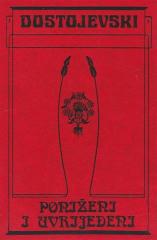
Ujakov san / Poniženi i uvrijeđeni

Ujakov san / Poniženi i uvrijeđeni

Fjodor Mihajlovič Dostojevski

Both works reflect Dostoevsky's early phase, with a focus on social criticism, psychological analysis and moral dilemmas, foreshadowing the themes of his later masterpieces.

Znanje, 1982.
Croatian. Latin alphabet. Hardcover.
13.2410.59 - 13.26
Svinjarija / Krokodil / Kockar / Vječiti muž

Svinjarija / Krokodil / Kockar / Vječiti muž

Fjodor M. Dostojevski

All the works published in this volume reflect Dostoevsky's ability to expose human frailties, social flaws and moral dilemmas through humor, satire and psychological depth, often with universal themes that still resonate today.

Znanje, 1982.
Croatian. Latin alphabet. Hardcover.
14.75
Tri mušketira 1-2

Tri mušketira 1-2

Alexandre Dumas

Dumas' version of the story depicts the adventures of d'Artagnan and his friends from 1625 to 1628.

Epoha, 1966.
Croatian. Latin alphabet. Hardcover with dust jacket.
The book consists of two volumes
9.48
Andrićeva lestvica užasa

Andrićeva lestvica užasa

Svetislav Basara

A Serbian writer known for his satirical novels, Andrić's Ladder of Horrors dissects the Balkan mentality through a parable of Yugo-nostalgia and national myths. The title alludes to Ivo Andrić as a litmus test for criticism – Balkans claim him or reject

24 sata, 2021.
Serbian. Latin alphabet. Paperback.
11.56
Deobe 1-3

Deobe 1-3

Dobrica Ćosić

This work, awarded the NIN Prize for that year, is considered one of the most significant in Serbian literature after World War II.

Prosveta, 1961.
Serbian. Cyrillic alphabet. Hardcover with dust jacket.
The book consists of 3 volumes
11.42