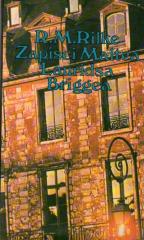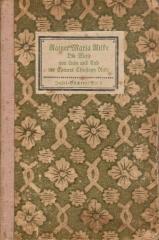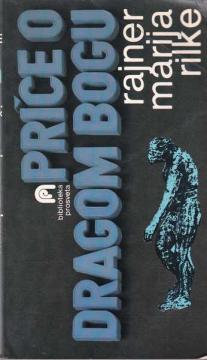
Priče o dragom Bogu
Rilke's Tales of a Dear God features a series of lyrical prose pieces about faith, childhood, and poverty, and occupy an important place in his early phase, in the transition from symbolism to more mature poetics.
Stories about the Dear God belong to the early period of Rainer Maria Rilke's creative work and are among the most interesting prose works of his youth. It is a book composed of a series of short, interconnected stories and lyrical prose in which faith, childhood, poverty, loneliness, kindness and the search for inner meaning are intertwined.
Instead of a strict religious or theological approach, Rilke presents God closely and intimately - as a silent presence that is sensed in human suffering, tenderness, modesty and inner experience. It is precisely this softness of tone, spiritual sensitivity and sense of the ineffable that give the book a special warmth and distinguish it from classical narrative prose.
In form, this work is on the border between story, legend, meditation and poetic prose. Rilke does not build tension through a grand plot, but through atmosphere, the rhythm of the sentence and the symbolic power of the scene. In these texts, the characteristics that would later make him one of the most important poets of European modernity are already clearly recognizable: a focus on inner life, a sense of silence and spiritual depth, and a distinct musicality of language.
The important place of the book in Rilke's oeuvre stems precisely from this early clarity of his voice. Stories about the Dear God shows how, at the beginning of his literary journey, the themes that would permanently occupy him were taking shape - the inner man, the relationship between the visible and the invisible, the presence of the sacred in everyday life, and the search for a deeper meaning of existence.
This is why this work is interesting not only as an early Rilke's prose work, but also as an important insight into the emergence of his recognizable poetics. For the reader, it remains a gentle, thoughtful, and spiritually refined book, and for lovers of literature, a valuable title that occupies a special place in the development of one of the key authors of modernity.
One copy is available