Magdin dnevnik
Rare book

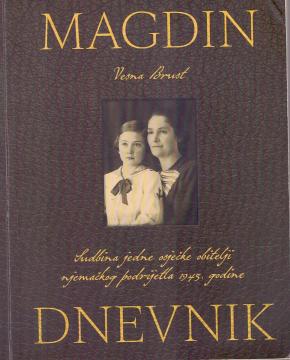
Magdin dnevnik

Vesna Brust

The fate of an Osijek family of German origin in 1945. As an authentic document of a post-war period, Magda's diary testifies to the victims of ordinary, small people who, although innocent, become guilty in the changed regime.

The novel "Magda's Diary" by Vesna Brust, a Croatian author of German origin, follows the fate of a German family in Osijek after World War II through the diary entries of Magdalena (Magda), a young girl from a prominent Danube Swabian family. The story begins in 1945, when the war ends, and Osijek, a multi-ethnic city full of German heritage – from Art Nouveau palaces to family traditions – faces communist revenge.

Magda, an intelligent and sensitive teenager, records everyday horrors: her father's arrest for alleged collaboration, her mother's concern for survival, the confiscation of her house and property, hunger and fear of the concentration camps. The family, which had contributed to the city's culture for centuries (as merchants, craftsmen and artists), is now declared an "enemy of the people". Magda describes the forced evictions of neighbors to Austria or the GDR, religious conflicts, silence about trauma and loss of identity – the German language is quietly fading, and family stories are sinking into oblivion.

Through Magda’s eyes, we see the generational transmission of pain: her grandfather’s war memories, her mother’s resignation, and her own struggle to preserve her dignity. The novel mixes intimate emotions with historical context – from Bleiburg to post-war repression – denouncing collective guilt and celebrating resilience. Brust, inspired by family history, writes poetically but in raw language, fusing German and Croatian, symbolizing the loss of roots.

In the end, Magda, now an adult, remains in Osijek, carrying the burden of silence, but also the hope of reconciliation. The diary is a tribute to the forgotten Danube Swabians, reminding us that the storms of war do not erase humanity.

Translation
Elizabeth Klein
Editor
Vesna Brust
Graphics design
Marko Jovanovac
Dimensions
21 x 17 cm
Pages
154
Publisher
Zemaljska udruga Podunavskih Švaba u Hrvatskoj, Osijek, 2019.
 
Latin alphabet. Paperback.
Language: Croatian.
ISBN
978-9-53803-603-3

No copies available

The last copy was sold recently.
 

Are you interested in another book? You can search the offer using our search engine or browse books by category.

You may also be interested in these titles

Historijska čitanka 2

Historijska čitanka 2

Miljenko Jergović

The first edition of the second part of the series with 5 new (bonus) stories by a famous writer and journalist. "This book completes the 'Historical Reader', a project - a column started on the pages of the Sarajevo magazine Dani, shortly after the end o

Durieux, 2004.
Croatian. Latin alphabet. Hardcover.
7.32
Skitam i pričam

Skitam i pričam

Momo Kapor

The book I'm wandering and talking was written for several years, and parts of it were published from Sunday to Sunday on the pages of the magazine Duga. Second, significantly expanded edition.

Znanje, 1982.
Serbian. Latin alphabet. Hardcover with dust jacket.
12.429.94
Knjiga za Maju: improvizacija na duši

Knjiga za Maju: improvizacija na duši

Marko Tomaš

Tomas' prose book of unrest, disintegration and attempts to unify beings, which means the world, which persistently eludes the author, from the days of nomads who did not create a foothold, to those when virtues and vices change the hierarchy and the mora

V.B.Z, 2023.
Croatian. Latin alphabet. Hardcover.
9.58
Pismo nerođenom djetetu

Pismo nerođenom djetetu

Oriana Fallaci

One of the most moving and courageous works of world literature of the 20th century. Written as a long monologue by a pregnant woman (Fallaci herself), the book is at once an intimate confession, a feminist manifesto, and a philosophical confrontation wit

Znanje, 2009.
Croatian. Latin alphabet. Paperback.
4.56
Pretapanja: Pannonius-Vrančić

Pretapanja: Pannonius-Vrančić

Helena Sablić Tomić

The book explores how different cultures and traditions intertwine and influence each other throughout history. Also, the book touches on the topics of identity, migration and transformation of societies.

Oksimoron, 2010.
Croatian. Latin alphabet. Hardcover.
14.62
Antidnevnik prisjećanja: Pogled unatrag i unaprijed

Antidnevnik prisjećanja: Pogled unatrag i unaprijed

Vladimir Devidé

Vladimir Devidé, a Croatian mathematician, Japanologist and essayist, creates an intimate, fragmentary autobiography in Anti-Diary of Recollections through around twenty texts – essays, stories, humorous and satirical articles, travelogues, reflections an

Znanje, 1995.
Croatian. Latin alphabet. Paperback.
11.26