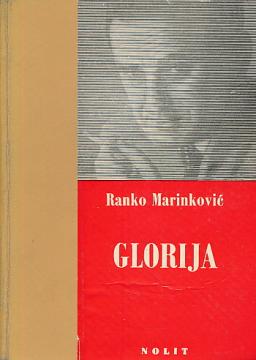
Glorija (mirakl u šest slika)

Glorija (mirakl u šest slika)

Ranko Marinković

The story tells us about the life of Gloria, a circus performer who converted and came to church, where she meets Don Jere.

Gloria worked in the glitter of the circus, but decides to end her career after giving up at the last minute from jumping towards the trapeze, which was torn. She believes that the Mother of God saved her from that jump, so she dedicates her life to her. During the difficult wartime, he goes to a church located in the middle of the Dalmatian rocky area and fundamentally changes his life. She becomes a nun Magdalena, trying to be kind, sincere and mild-mannered.

In the church, he meets don Jere, an ambitious young priest who wants to advance in the church hierarchy. Don Zane, the wise librarian, looks ironically at Don Jera's attempts. Don Jere, enchanted by Gloria's beauty, decides to use her to attract believers to the church and gain fame. Sister Magdalena sits on the altar like a statue every day, instead of the Mother of God. But don Jere is not satisfied because his feelings for her are a mortal sin.

Circus performer Floki Fleche, Gloria's father, also enters the story. "Gloria" is a drama that symbolically condemns dogmatism and totalitarianism and the impotence of all ideologies.

Editor
Jovan Nedeljković
Illustrations
Sreten Grujić
Graphics design
Lj. Pavićević Fis
Dimensions
17 x 12.5 cm
Pages
215
Publisher
Nolit, Beograd, 1966.
 
Latin alphabet. Hardcover.
Language: Croatian.

No copies available

The last copy was sold recently.
 

Are you interested in another book? You can search the offer using our search engine or browse books by category.

You may also be interested in these titles

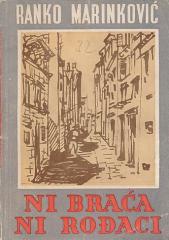
Ni braća ni rođaci

Ni braća ni rođaci

Ranko Marinković
Nakladni zavod Hrvatske, 1949.
Croatian. Latin alphabet. Paperback.
6.685.01
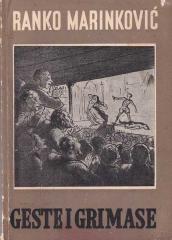
Geste i grimase

Geste i grimase

Ranko Marinković

A collection of theater essays and criticism in which Ranko Marinković analyzes great works and authors of world and Croatian theater, reflecting on art, acting, and dramatic expression.

Zora, 1951.
Croatian. Latin alphabet. Paperback.
9.42
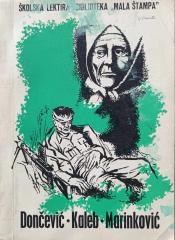
Bezimeni

Bezimeni

Ivan Dončević, Vjekoslav Kaleb, Ranko Marinković
NIP Štampa, 1966.
Croatian. Latin alphabet. Paperback.
2.36 - 4.22
Proces

Proces

Franz Kafka

Kafka wrote The Process between 1914 and 1915, published posthumously in 1925. The novel is unfinished but with an added final chapter by Max Brod. Edition with a foreword by B. Živojinović and an afterword by Walter Killi.

BIGZ, 1990.
Serbian. Latin alphabet. Paperback.
4.26
Rudnik čvaraka

Rudnik čvaraka

Tomislav Šovagović

The debut work of Croatian writer Tomislav Šovagović, awarded the Josip and Ivan Kozarac Award in 2012, is a dedication to Slavonia – the region of his childhood that the author, born in Dalmatia, observes with foreign but tender eyes.

Mozaik knjiga, 20112.
Croatian. Latin alphabet. Paperback.
11.56
Crna kutija

Crna kutija

Amos Oz

The Black Box is a kaleidoscope of married life and love relationships. It is a novel that implicitly speaks about all of us.

Hena Com, 2001.
Croatian. Latin alphabet. Hardcover.
10.988.24