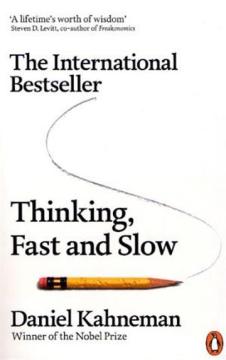
Thinking, Fast and Slow

Thinking, Fast and Slow

Daniel Kahneman

Thinking, fast and slow is a monumental work by the famous Nobel laureate and one of the world's most important psychologists. Thinking, fast and slow will change the way we are used to thinking about thinking.

Winner of the Nobel Prize in Economics, Daniel Kahneman studied the rational model of judgment and decision-making in his innovative work in the field of psychology. He is one of the most significant thinkers today whose ideas and achievements have influenced many areas of human activity - corporate business, medicine and politics. Until this book, he did not summarize his research and reflections in one place.

In the book Thinking, Fast and Slow, Kahneman takes us on a journey that will reveal the foundations of how our mind works. It will explain the way the two systems that drive our thinking and the way we make decisions work. System 1 is fast, intuitive and emotional. System 2 is slower, more consultative, more rational, more logical.

Kahneman exposes his unusual ability to think quickly - but also his misconceptions and prejudices. At the same time, he warns about the great influence that intuitive impressions have on our thoughts and choices. The role of optimism when opening a new business, the meaning of good prediction of possible risks at home and at work, difficulties in predicting what will make us happy in the future, the illusion of expert opinion... All of this can only be understood if we know how the two systems work together when shaping our assessments and making decisions.

Dimensions
20 x 13 cm
Pages
499
Publisher
Penguin Books Ltd, London, 2012.
 
Latin alphabet. Paperback.
Language: English.
ISBN
978-0-14103-357-0

One copy is available

Condition:Used, excellent condition
 

Are you interested in another book? You can search the offer using our search engine or browse books by category.

You may also be interested in these titles

Buka: Zašto griješimo u prosuđivanju i kako to izbjeći?

Buka: Zašto griješimo u prosuđivanju i kako to izbjeći?

Daniel Kahneman, Olivier Sibony, Cass R. Sunstein

If you like Kahneman's approach, "Noise" is the logical next step after "Thinking, Fast and Slow." It shows that even when there is no bias, our judgments are still highly unreliable—and offers concrete ways to fix it.

Mozaik knjiga, 2022.
Croatian. Latin alphabet. Paperback.
17.52
Kontraznanje: Kako smo podlegli teorijama zavjere, nadriliječništvu, pseudoznanosti i kvazipovijesti

Kontraznanje: Kako smo podlegli teorijama zavjere, nadriliječništvu, pseudoznanosti i kvazipovijesti

Damian Thompson

A book by British journalist Damian Thompson defines counterknowledge as false information packaged to appear as fact, warning of a dangerous trend of suppressing empirical science in contemporary society.

Algoritam, 2009.
Croatian. Latin alphabet. Paperback.
6.44
Wer wann was: Ideen, Köpfe, Ereignisse

Wer wann was: Ideen, Köpfe, Ereignisse

Peter Albrecht

A calendar guide through history: for every day of the year, it provides interesting inventions, important people and key events. A fun and useful overview of world history for younger ages.

Edition XXL, 2005.
German. Latin alphabet. Hardcover.
3.76
Posljednji dani ljudi

Posljednji dani ljudi

Camille Flammarion

The second part of Flammarion's popular science work The Doom of the World (1894.). A speculative account of life on Earth in ten million years and the gradual end of humanity. Popular science with elements of science fiction.

Hrvatsko prirodoslovno društvo, 1920.
Croatian. Latin alphabet. Paperback.
12.34
Umijeće stvaranja uspomena: Kako stvarati i pamtiti sretne trenutke

Umijeće stvaranja uspomena: Kako stvarati i pamtiti sretne trenutke

Meik Wiking

From the bestselling author of Hygge: The Danish Recipe for a Happy Life and Lykke: The Search for the World's Happiest People comes a new guide. Meik Wiking teaches you how to consciously create strong, happy memories so that life slows down and becomes

Mozaik knjiga, 2020.
Croatian. Latin alphabet. Hardcover.
12.32
Nuklearna moć

Nuklearna moć

Volter C. Paterson

The book is balanced but critical of the nuclear industry — highlighting the technical, economic and political weaknesses of the programs in different countries (USA, UK, France, etc.).

Rad, 1987.
Serbian. Latin alphabet. Hardcover.
8.98