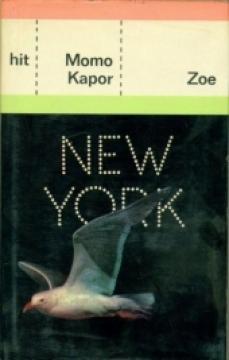
Zoe

Zoe

Momo Kapor

The novel "Zoe" (1978), one of Momo Kapor's most popular works, follows Arsen Lero, a 39-year-old art historian from the fictional Republic of Kosiliya – a small island under an authoritarian regime.

Ler, a married father of a young daughter, Maja, and curator of a gallery in the city of Mimosa, receives an assignment from the Minister of Culture to purchase the portrait "Girl with a Doll" by the painter Valdemar Udini, a key piece of national heritage, at an auction in New York. He travels by plane via Athens to Megapolis, experiencing the shock of the contrast between provincial life and the chaotic city.

At the auction, with the help of the consulate, he buys the painting for $1,200, but is confronted by Princess Zoe Kudelin, an exiled member of a deposed royal dynasty, born in 1938 - the same day as Ler. Zoe, a cosmopolitan woman in exile, lives in Greenwich Village, dealing in promotions and fashion to survive. She claims that the portrait is her boyish self, painted by Udini. The two begin a passionate romance: walks in Central Park, dinners at the "Russian Tea Room", visits to museums such as the Guggenheim, and exploring the Kosilian community in the Bronx, at the "Mimosa" tavern. Ler moves in with her, changing his habits, while facing offers from rich collectors and traces of the past.

Zoe bears the burden of exile: the death of her father, King Nicholas IV, at the Savoy Hotel, and only has a button from his shirt as an inheritance. The novel explores the themes of totalitarian repression (censorship, paranoia, prohibition of escape), exile and nostalgia for a lost home, the identity of a small nation in world chaos (Kozilia as a "non-existent" island), art as resistance and a bridge to the roots, and love between the past and the present - a modern fairy tale about a shepherd and a princess. Through satirical descriptions, introspective monologues and vivid urban scenes, Kapor shows the contrast of tradition and modernity, the poverty of emigrants and false splendor, eroticism and loneliness, reminding us that exile is not only a geographical, but also a mental phenomenon.

Editor
Zlatko Crnković
Graphics design
Alfred Pal
Dimensions
20 x 12 cm
Pages
167
Publisher
Znanje, Zagreb, 1978.
 
Latin alphabet. Hardcover with dust jacket.
Language: Croatian.

One copy is available

Condition:Used, excellent condition
 

Are you interested in another book? You can search the offer using our search engine or browse books by category.

You may also be interested in these titles

Provincijalac

Provincijalac

Momo Kapor

Koliko su Foliranti priča o Kaporovim studentskim danima u Beogradu kasnih pedesetih, Provincijalac je knjiga koja budi uspomene na njegovo djetinjstvo u Sarajevu, gdje je autor proveo prve godine svog života.

Znanje, 1978.
Serbian. Latin alphabet. Hardcover with dust jacket.
6.42
Knjiga žalbi

Knjiga žalbi

Momo Kapor

Knjiga žalbi je objavljena prvi put davne 1984. godine i odmah je privukla veliku pažnju književne publike i kritike.

Znanje, 1984.
Croatian. Latin alphabet. Hardcover with dust jacket.
9.54 - 9.56
Foliranti

Foliranti

Momo Kapor

Der 37-jährige Kapor erinnert sich an sich selbst im Alter von neunzehn Jahren, an das damalige Belgrad und an all die Menschen, die ihm damals wichtig waren. Dieses Buch ist ein an sie gerichteter Brief, gleichzeitig aber auch ein eindrucksvolles Tagebuc

Znanje, 1985.
Serbian. Latin alphabet. Paperback.
4.68
Vreća kostiju

Vreća kostiju

Stephen King

The novel follows Mike Noonan, a successful writer who, after the death of his wife, suffers from writer's block and nightmares. Four years later, he decides to retreat to their summer home, where he is confronted with supernatural phenomena and secrets f

Algoritam, 2000.
Croatian. Latin alphabet. Hardcover.
72.34
Iskre u tami

Iskre u tami

Mihajilo Radotić Glumac
RO Dragan Srnić, 1981.
Serbian. Latin alphabet. Paperback.
5.864.40
Kao mraz: roman o nestajanju

Kao mraz: roman o nestajanju

Zora Dirnbach
Novi Liber, 2000.
Croatian. Latin alphabet. Paperback.
9.99