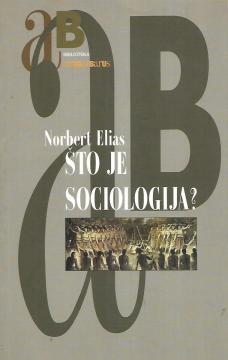
Što je sociologija?

Što je sociologija?

Norbert Elias

A classic work by one of the most influential sociologists of the 20th century, the founder of "figurative" or "process" sociology. The book is a programmatic manifesto against the then dominant structural-functionalist paradigm (Parsons) and pure positiv

Elias elaborates on his key concepts in the book:

  • “figure” (the interdependence of individuals as the basic unit of analysis, not “individual” or “society” as separate instances)
  • “process” – society is not a static state but a long-term, unintentional process (the most famous example: “civilization process”)
  • “social configuration” – a network of interdependencies that shape the behavior of individuals
  • critique of “homo clausus” – the illusion that the individual is a closed box, separated from others

Elias introduces familiar metaphors: society as a dance (four or more people dancing together – there is no dancer without a dance), a game (changing the balance of power changes the rules) and the example of two warring villages that, without intention, create an increasingly complex social structure.

A special chapter is dedicated to “game models” – simple schemes that show how monopolies of power, states and civilizations are born from interdependencies. In the Croatian context, the book has become required reading at universities, as it offers a completely different view of the wars of the 1990s: not as a conflict of "peoples" but as a process of disintegration of long-term interdependencies.

Original title
Was ist Soziologie?
Translation
Srećko Horvat
Editor
Rade Kalanj
Dimensions
24 x 15 cm
Pages
162
Publisher
Antibarbarus, Zagreb, 2007.
 
Latin alphabet. Paperback.
Language: Croatian.
ISBN
978-9-53249-046-6

One copy is available

Condition:Used, excellent condition
 

Are you interested in another book? You can search the offer using our search engine or browse books by category.

You may also be interested in these titles

Putovima hrvatskoga književnog jezika

Putovima hrvatskoga književnog jezika

Zlatko Vince

The book is still required reading at philological faculties today because it systematically connects language with literature and social context for the first time. It is written clearly, without ideological exclusivity, which was a rarity in 1990.

Nakladni zavod Matice hrvatske, 1990.
Croatian. Latin alphabet. Hardcover with dust jacket.
17.26
Opća kultura III

Opća kultura III

Nikola Bačić

This is the third part of a series of textbooks that covered basic knowledge from different areas of human creativity, society and civilization.

VISOKA INDUSTRIJSKO-PEDAGOŠKA ŠKOLA U RIJECI, 1971.
Croatian. Latin alphabet. Paperback.
8.98
Ikonosfera

Ikonosfera

Mieczyslaw Porebski
Prosveta, 1978.
Serbian. Latin alphabet. Paperback.
5.504.13
Etnografija komunikacije

Etnografija komunikacije

Dell Hymes
Biblioteka XX vek, 1980.
Serbian. Latin alphabet. Paperback.
6.32
Hrvatska - Brazil : Kulturno - povijesne veze

Hrvatska - Brazil : Kulturno - povijesne veze

Nikica Talan
Društvo hrvatskih književnika, 1998.
Croatian. Latin alphabet. Paperback.
14.22
Ova jedina zemlja (Idemo li u katastrofu ili treću revoluciju?)

Ova jedina zemlja (Idemo li u katastrofu ili treću revoluciju?)

Rudi Supek

Supek emphasizes the need for global cooperation and responsibility to ensure the sustainability of our planet.

Naprijed, 1973.
Croatian. Latin alphabet. Paperback.
5.32