Veliko proljeće
Antique
Rare book

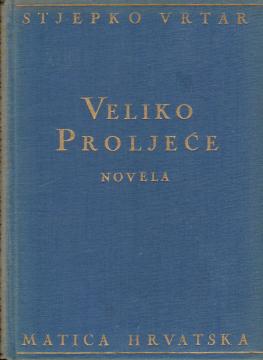
Veliko proljeće

Stjepko Vrtar

The Great Spring (1933) depicts the awakening and rebirth of the Croatian village and the common man in the interwar period – a symbolic depiction of the national and social spring, the peasant movement, and the personal maturation of the main character.

1,341 Stjepko Vrtar (1890–1945?), a Croatian writer and financial expert, activist of the Peasant Unity, published the novella Veliko proljeće in 1933, published by Matica hrvatska (Naklada Pramatice). The work belongs to the socially engaged prose of the interwar period with emphasized folk and peasant motifs.

The novella depicts the awakening of the Croatian people in the 1930s through the fate of a young peasant or intellectual from the village. The author describes difficult living conditions, poverty, political pressure and the national question, but also hope for a better tomorrow – the “great spring” as a metaphor for national revival, the strengthening of the peasant movement (HSS) and spiritual awakening. Vrtar combines a realistic depiction of rural life with lyrical and idealistic passages, emphasizing the themes of justice, education, solidarity and love for the land and people.

The style is accessible, warm and engaged, typical of literature close to the Peasant Unity. The work exudes optimism and faith in the strength of the common man, despite the difficult social conditions of the Kingdom of Yugoslavia. Critics have noted the authenticity in the depiction of the rural mentality and social problems.

The Great Spring is a relatively rare antiquarian edition and represents an interesting example of the literature of the Croatian peasant movement in the interwar period. Today it is read as a document of the times and a testimony to the national and social hopes of the 1930s.

Dimensions
20 x 14 cm
Pages
100
Publisher
Matica hrvatska, Zagreb, 1933.
 
Latin alphabet. Hardcover.
Language: Croatian.

One copy is available

Condition:Used, excellent condition
 

Are you interested in another book? You can search the offer using our search engine or browse books by category.

You may also be interested in these titles

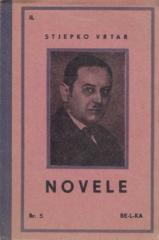
Novele

Novele

Stjepko Vrtar
Minerva nakladna knjižara, 1943.
Croatian. Latin alphabet. Paperback.
5.323.72
Blato

Blato

Milana Vlaović

Miana Vlaović's debut novel is a story about three generations of women in a patriarchal province, filled with recurring patterns of fate - love, betrayal, poverty, violence, and small struggles for dignity.

V.B.Z, 2007.
Croatian. Latin alphabet. Paperback.
6.38
Krvava arena

Krvava arena

Vicente Blasco Ibanez

The Bloody Arena (1908) is a naturalistic novel about the rise and fall of bullfighter Juan Gallardo. A poor young man becomes a famous matador, but is destroyed by love, vice, fear, and tragedies in the arena – a critique of Spanish bullfighting and soci

Naprijed, 1984.
Croatian. Latin alphabet. Hardcover with dust jacket.
4.76
Za ljubav sina

Za ljubav sina

Herve Bazin

An intimate, autobiographical drama about fatherhood, guilt, and complex family relationships. The main character is Daniel, a middle-aged widower who is raising three children alone: ​​twins (an older son and a daughter) and the youngest son Bruno.

Svjetlost, 1965.
Croatian. Latin alphabet. Paperback.
2.76
Vrijeme nasilja

Vrijeme nasilja

Jean-Pierre Simon

A Time of Violence (1966) is an anti-war and activist novel by French writer Jean-Pierre Simon, a lesser-known author from the mid-20th century, whose work bears traces of leftist literature of the 1930s and 1940s.

Svjetlost, 1965.
Croatian. Latin alphabet. Paperback.
2.46
Pokošeno polje

Pokošeno polje

Branimir Ćosić

Mown Fields (1933) represents the culmination and swan song of a life that ended too soon – the author finished the novel just five months before his death from tuberculosis, at the age of thirty-one.

Svjetlost, 1961.
Serbian. Latin alphabet. Hardcover.
The book consists of two volumes
5.34