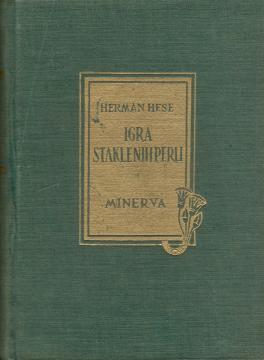
Igra staklenih perli
Rare book

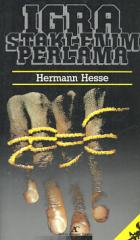
Igra staklenih perli

Hermann Hesse

In the distant future, in the province of Castalia, the master of the Glass Bead Game, Joseph Knecht, reaches the pinnacle of his intellectual and spiritual life. But the conflict between pure spirit and the real world leads him to a fateful choice.

The Glass Bead Game (1943) is Hermann Hesse's masterpiece and his last great novel, for which he received the Nobel Prize for Literature in 1946.

The plot is set in an imaginary future, in the elite spiritual province of Castalia, where the brightest minds devote themselves to the Glass Bead Game – the supreme synthesis of all arts, sciences, philosophy and spirituality. The game is at once meditation, music and the universal language of knowledge. At the center of the story is Joseph Knecht, a brilliant player who rises to the highest position – Master of the Game (Magister Ludi).

Through Knecht's life, Hesse deeply explores eternal themes: the relationship between spirit and life, intellect and emotion, withdrawal from the world and responsibility towards it. The novel is rich in philosophical reflections, subtle irony and a profound humanistic message. In addition to the main story, the book also contains Knecht's "posthumous writings" – three biographies that further enrich the picture of his inner search.

The Glass Bead Game is considered one of the most important European novels of the 20th century. It is an intellectually demanding but extremely rewarding work – meditative, wise and profound. Here, at the peak of his creativity, Hesse asks the question: can man live only in the world of the spirit, or is he obliged to return to the real, imperfect world?

The book will especially delight lovers of philosophical novels, admirers of Hesse (Siddhartha, Steppenwolf, Narcissus and Chrysostom), and anyone looking for a deep, reflective read that is read slowly and repeatedly.

Original title
Das Glasperlenspiel
Translation
Mihailo Smiljanić
Editor
Tanasije Mladenović
Illustrations
Nataša Todorović
Graphics design
Stevan Vujkov
Dimensions
20 x 14 cm
Pages
474
Publisher
Minerva, Subotica, 1960.
 
Latin alphabet. Hardcover.
Language: Croatian.

One copy is available

Condition:Unused
 

Are you interested in another book? You can search the offer using our search engine or browse books by category.

You may also be interested in these titles

Stepski vuk

Stepski vuk

Hermann Hesse
BIGZ, 1987.
Serbian. Latin alphabet. Paperback.
5.764.61
Narcis i Zlatousti

Narcis i Zlatousti

Hermann Hesse

The book tells about the different life paths and different worldviews of Narcissus, a monk and scholar, focused exclusively on the spiritual, and Zlatoust, an artist, who wants to immortalize the worldly and glorify God through the visible with his creat

Svjetlost, 1986.
Serbian. Latin alphabet. Hardcover.
7.32
Istina i druge laži

Istina i druge laži

Sascha Arango

Henry is a successful writer. He is classy, ​​generous and very dangerous. Henry is actually an unscrupulous hochstapler who has secured an extremely comfortable life for himself.

Znanje, 2017.
Croatian. Latin alphabet. Paperback.
2.94 - 2.96
Moć ljubavi

Moć ljubavi

Hedwig Courths-Mahler

Eva Hermsdorf takes over the position of governess at the court of Count Rudolph von Plessen. A deep love quickly develops between the two, but a secret love makes it impossible...

Matica hrvatska, 1980.
Croatian. Latin alphabet. Hardcover with dust jacket.
3.48
Odbjegli konj

Odbjegli konj

Martin Walser

The Runaway Horse is a 1978 novel by the German writer Martin Walser, which immediately became a bestseller.

Znanje, 1983.
Croatian. Latin alphabet. Hardcover with dust jacket.
3.64
Dnevnik Anne Frank

Dnevnik Anne Frank

Anne Frank

Anne Frank died in March 1945 at the age of fifteen in the Bergen-Belsen concentration camp. Two years after that, the book The Diary of Anne Frank was published.

Marjan tisak, 2000.
Croatian. Latin alphabet. Paperback.
9.54