O podrijetlu i zgodama Slavena
Rare book

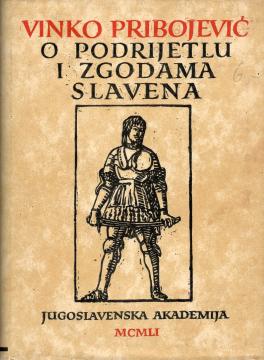
O podrijetlu i zgodama Slavena

Vinko Pribojević

A critical bilingual (Latin-Croatian) edition of Pribojević's speech from 1525, which celebrates the origin, glory, and history of the Slavs, identifying them with the Illyrians and other ancient peoples. A classic work of early Pan-Slavism.

The work of Vinko Pribojević (Vincentius Priboevius, c. 1480 – after 1532), a Dominican and humanist from Hvar, is one of the most important works of Croatian Latin literature of the 16th century. The speech De origine successibusque Slavorum (On the origin and adventures of the Slavs) was held in 1525 on Hvar, and was first printed in Venice in 1532.

The 1951 JAZU edition (Hrvatski latinisti library, book 1) is bilingual — it brings the original Latin text with a Croatian translation. It was edited by academician Grga Novak, who wrote an extensive introduction, notes and prepared the text for printing. The translation into Croatian was made by Veljko Gortan, who also compiled the index. This is the first scientific-critical edition of the work, which made it accessible to contemporary readers with the necessary equipment.

Pribojević's work is divided into three parts. In the first, the author develops the mythological-genealogical history of the Slavs, connecting them with their biblical ancestors (through Japheth) and ancient peoples — the Illyrians, Thracians, Macedonians, Goths, Sarmatians and Vandals. He claims their autochthonousness in the Balkans and continuity since ancient times. The second part celebrates the successes and glory of the Slavs, and the third glorifies Dalmatia and their native Hvar, bringing valuable ethnographic and historical data about the island in the 16th century.

The work is a pioneer expression of pan-Slavism in Croatian culture: it promotes the idea of ​​the common origin and greatness of all Slavs, which later influenced the Illyrian movement and national consciousness. The style is typical Renaissance humanism — rhetorically lavish, full of quotations from ancient writers, biblical symbolism and classical allusions.

Original title
De origine successibusque Slavorum
Translation
Veljko Gortan
Editor
Nikola Majnarić
Dimensions
20.5 x 15 cm
Pages
247
Publisher
Jugoslavenska akademija znanosti i umjetnosti (JAZU), Zagreb, 1951.
 
Latin alphabet. Hardcover with dust jacket.
Language: Croatian.

One copy is available

Condition:Unused
 

Are you interested in another book? You can search the offer using our search engine or browse books by category.

You may also be interested in these titles

Osječka bibliografija I-II: Tiskarsko-izdavačka djelatnost u Osijeku od 1742. do 1978. godine

Osječka bibliografija I-II: Tiskarsko-izdavačka djelatnost u Osijeku od 1742. do 1978. godine

Marija Malbaša

The capital bibliography of printing and publishing activities in Osijek from 1742 to 1978 lists thousands of books, newspapers, magazines and small print, regardless of language. A classic of Croatian bibliographic creativity of the 20th century.

Jugoslavenska akademija znanosti i umjetnosti (JAZU), 1981.
Croatian. Latin alphabet. Hardcover.
The book consists of two volumes
48.32
Liburnijske teme 8: Brseč i Brešćina

Liburnijske teme 8: Brseč i Brešćina

"Liburnian Topics" represent a valuable serial publication (proceedings) initiated by the Chair of the Čakavian Parliament in Opatija with the aim of researching and preserving the historical, cultural and natural heritage of the Liburnian region.

Čakavski sabor, 1994.
Croatian. Latin alphabet. Paperback.
12.369.27
Bosna i Hercegovina: Opisana i ocrtana

Bosna i Hercegovina: Opisana i ocrtana

Rudolf Maldini-Wildenhainski

Rudolf Baron Maldini Wildenhainski vividly describes the natural beauties, landscapes, old towns and customs of Bosnia and Herzegovina at the beginning of the 20th century. Bibliophile edition on kunstdruck paper with 136 images.

Hrvatsko planinarsko društvo, 1909.
Croatian. Latin alphabet. Hardcover.
127.56
Starohrvatska seoska zajednica

Starohrvatska seoska zajednica

Miho Barada

In his work Starohrvatska seoska zajednica (The Old Croatian Village Community) (1957), Miho Barada analyzes the social and agrarian organization of early medieval Croatian villages, their institutions, ownership relations, and common land based on origin

Jugoslavenska akademija znanosti i umjetnosti (JAZU), 1957.
Croatian. Latin alphabet. Paperback.
10.00
Obrtna politika

Obrtna politika

Ivan Čupak

A practical and programmatic book on craft policy in Croatia at the end of World War I. Ivan Čupak analyzes the problems, position and prospects of Croatian crafts and proposes measures for their protection and improvement.

Vlastita naklada, 1918.
Croatian. Latin alphabet. Hardcover.
12.34