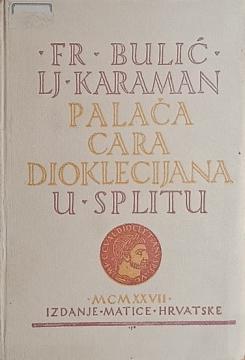
Palača cara Dioklecijana u Splitu
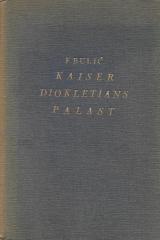
The work of Bulić and Karaman depicts the creation and development of Diocletian's Palace in Split, its historical transformation and significance as a monument of Roman architecture and later an urban center.
Frane Bulić as the author and Ljubo Karaman as a collaborator in writing the work The Palace of Emperor Diocletian in Split, have created one of the most important scientific studies on late antique architecture on the eastern Adriatic coast, which has remained meritorious in its field to this day.
The authors analyze the emergence of the palace of the Roman emperor Diocletian in the late 3rd and early 4th centuries, when the complex was built as a luxurious imperial residence and at the same time as a fortified architectural complex. The complexity of its plan, which combines elements of a Roman villa, a military camp and representative imperial architecture, is particularly emphasized.
The work also traces the historical transformation of the palace after Diocletian's death, when the monumental antique complex gradually transformed into a living city core from which Split emerged. The continuity of life within the walls and the adaptation of antique buildings to medieval and modern functions are emphasized.
A significant part of the study is dedicated to a detailed analysis of architectural ensembles such as the peristyle, the mausoleum (later the Cathedral of St. Domnius), the gates and the defensive systems, along with their historical and artistic evaluation.
The work is still representative in its field today because it represents a fundamental scientific synthesis of Diocletian's Palace. Its precise documentation, systematic methodology and interpretative clarity make it one of the key reference works of Croatian archaeology and art history, and a permanently relevant source for the study of the ancient heritage and urban development of Split.
One copy is available
- The cover is missing
- Traces of patina