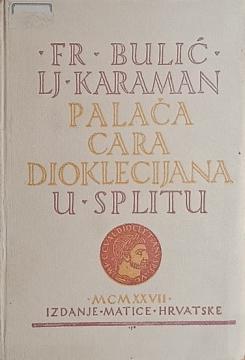
Palača cara Dioklecijana u Splitu
Antikvitet
Rijetka knjiga

Palača cara Dioklecijana u Splitu

Frane Bulić, Ljubo Karaman

The work of Bulić and Karaman depicts the creation and development of Diocletian's Palace in Split, its historical transformation and significance as a monument of Roman architecture and later an urban center.

Frane Bulić as the author and Ljubo Karaman as a collaborator in writing the work The Palace of Emperor Diocletian in Split, have created one of the most important scientific studies on late antique architecture on the eastern Adriatic coast, which has remained meritorious in its field to this day.

The authors analyze the emergence of the palace of the Roman emperor Diocletian in the late 3rd and early 4th centuries, when the complex was built as a luxurious imperial residence and at the same time as a fortified architectural complex. The complexity of its plan, which combines elements of a Roman villa, a military camp and representative imperial architecture, is particularly emphasized.

The work also traces the historical transformation of the palace after Diocletian's death, when the monumental antique complex gradually transformed into a living city core from which Split emerged. The continuity of life within the walls and the adaptation of antique buildings to medieval and modern functions are emphasized.

A significant part of the study is dedicated to a detailed analysis of architectural ensembles such as the peristyle, the mausoleum (later the Cathedral of St. Domnius), the gates and the defensive systems, along with their historical and artistic evaluation.

The work is still representative in its field today because it represents a fundamental scientific synthesis of Diocletian's Palace. Its precise documentation, systematic methodology and interpretative clarity make it one of the key reference works of Croatian archaeology and art history, and a permanently relevant source for the study of the ancient heritage and urban development of Split.

Dimenzije
22 x 16 cm
Broj strana
285
Nakladnik
Matica hrvatska, Zagreb, 1927.
 
Latinica. Tvrde korice.
Jezik: Hrvatski.

Jedan primjerak je u ponudi

Stanje:Korišteno, u dobrom stanju (tragovi korištenja)
Oštećenja / nepogodnosti:
  • The cover is missing
  • Traces of patina
Dodano u košaricu!
 

Zanima Vas i neka druga knjiga? Možete pretražiti našu ponudu pomoću tražilice ili prelistati knjige po kategorijama.

Možda će Vas zanimati i ovi naslovi

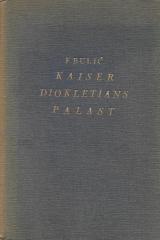
Kaiser Diokletians Palast in Split

Kaiser Diokletians Palast in Split

Frane Bulić, Ljubo Karaman
Matica hrvatska, 1929.
Njemački. Latinica. Tvrde korice.
19,99
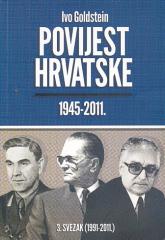
Povijest Hrvatske 1945.-2011. (1-3.svezak)

Povijest Hrvatske 1945.-2011. (1-3.svezak)

Ivo Goldstein

Goldstein's "History of Croatia" is one of the most reliable books published in the past period, especially rich in historical works.

EPH media d. o. o., 2011.
Hrvatski. Latinica. Broširano.
Knjiga se sastoji od tri toma
4,32
Povijest sporta grada Osijeka

Povijest sporta grada Osijeka

From the establishment of sports clubs and societies in the city until 1996

Gradsko poglavarstvo grada Osijeka, 1998.
Hrvatski. Latinica. Tvrde korice.
19,9813,99
Hrvati koji su stvarali Europu

Hrvati koji su stvarali Europu

Ivan Tanta

The book collects short biographies of thirty Croatians who, through their work in various fields of science, art and society, have made a contribution to European history.

Stari grad, 2003.
Hrvatski. Latinica. Tvrde korice.
6,72 - 6,82
Zapisnik općine Osijek - Tvrđa od 1745. do 1770 godine

Zapisnik općine Osijek - Tvrđa od 1745. do 1770 godine

Stjepan Sršan

After the first volume of the book "The oldest record of the municipality of Osijek - Tvrđa from 1705 to 1746." this is the second volume of the book, which covers the period from 1745 to 1770.

Historijski arhiv u Osijeku, 1987.
Hrvatski. Latinica. Tvrde korice.
12,36
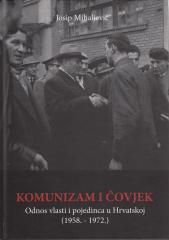
Komunizam i čovjek: Odnos vlasti i pojedinca u Hrvatskoj (1958.–1972.)

Komunizam i čovjek: Odnos vlasti i pojedinca u Hrvatskoj (1958.–1972.)

Josip Mihaljević

Josip Mihaljević's book analyzes the relationship between the government and the individual in communist Croatia (1958–1972), through repressive mechanisms, ideological pressures, and restrictions on personal freedom in the socialist system.

Hrvatski institut za povijest, 2016.
Hrvatski. Latinica. Tvrde korice.
17,26