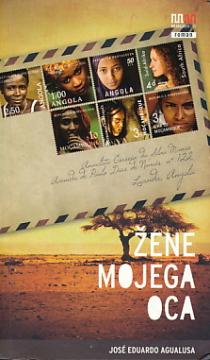
Žene mojega oca

Žene mojega oca

José Eduardo Agualusa

With the novel My father`s women Agualus, he continues his critical and ironic review of his native Angola.

The structure of the novel shows calm virtuosity, it mixes real people (among them Agualusa himself), texts that seem credible (diary pages, excerpts from letters, recordings), poems from the colonial era, literary quotations (Kapuscinski, Pessoa, etc.), in one elegant patchwork. This novel is an odyssey across the physical and human map of Africa.

Original title
As mulheres do meu pai
Translation
Tanja Tarbuk
Editor
Branko Čegec
Dimensions
20 x 12 cm
Pages
393
Publisher
MeandarMedia, Zagreb, 2010.
 
Latin alphabet. Paperback.
Language: Croatian.
ISBN
978-9-53735-567-8

One copy is available

Condition:Used, excellent condition
 

Are you interested in another book? You can search the offer using our search engine or browse books by category.

You may also be interested in these titles

Melem za dušu 2

Melem za dušu 2

Jack Canfield, Mark Victor Hansen
Mozaik knjiga, 1998.
Croatian. Latin alphabet. Hardcover.
7.265.45
Minus sapiens

Minus sapiens

Zoran Roško
Oceanmore, 2017.
Croatian. Latin alphabet. Paperback.
9.98
Tajni život Pippe Lee

Tajni život Pippe Lee

Rebecca Miller

The author's first novel. It was adapted into a film starring Robin Wright Penn, Julianne Moore, Keanu Reeves and Winona Ryder.

Profil Knjiga, 2012.
Croatian. Latin alphabet. Paperback.
3.98
Dok ležah na samrti

Dok ležah na samrti

William Faulkner

Faulkner's 1930 novel, a classic example of modernist literature. It is often compared to Joyce's "Ulysses" for its innovative structure, but is more accessible due to its focus on family.

Rad, 1985.
Croatian. Latin alphabet. Paperback.
3.26
Specijalne cipele

Specijalne cipele

Dragan Ogurlić
RZ RK SSOH, 1987.
Croatian. Latin alphabet. Paperback.
4.22
Mrtvi kapitali

Mrtvi kapitali

Josip Kozarac

"Dead Capitals" (1890) is one of the most important works of Croatian realism and a strong critique of the social stagnation of the time. The novel shows the economic and social neglect of Slavonian villages under the Austro-Hungarian Empire through the c

Mladost, 1971.
Croatian. Latin alphabet. Hardcover.
3.56 - 6.22