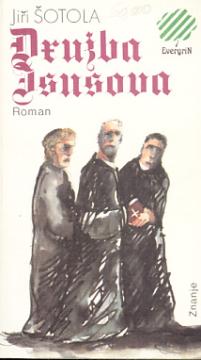
Družba Isusova

Družba Isusova

Jiří Šotola

The Society of Jesus (1969) by Jiří Šotola, the debut work of the Czech poet, is a historical novel set during the Counter-Reformation, which subtly alludes to contemporary conditions in Czechoslovakia under communism.

The plot follows Father Vojtěch Had and Countess Maria Maximiliana, whose fates intertwine in the conflict between the individual and the powerful Catholic Jesuit order. The novel explores themes of obedience, ideological oppression, and the loss of spiritual and human freedom. Vojtěch Had, a Jesuit priest, is faced with an internal conflict between his conscience and the strict rules of the order, where obedience is the highest value. Countess Maria Maximiliana, passionate and rebellious, comes into conflict with the church hierarchy, which leads to her spiritual and physical downfall. Their paths lead to a tragic end, where ideology suffocates humanity, leaving them as "empty physical shells". The novel is dark, with a heavy atmosphere, but also a layered narrative and dialogues that emphasize moral dilemmas. Šotola masterfully uses historical context to criticize totalitarian systems, making the novel universal. Croatian critic Ljudevit Bauer compared it to the novel Dervish and the Death of Meša Selimović due to similar themes of the conflict between the individual and the system. Published in 1975 in Croatia, the novel received critical acclaim and was adapted into a film in 2004, directed by Silvij Petranović.

Translation
Nikola Kršić
Dimensions
20 x 12 cm
Publisher
Znanje, Zagreb, 1988.
 
Latin alphabet. Paperback.
Language: Croatian.

Two copies are available

Copy number 1

Condition:Used, excellent condition

Copy number 2

Condition:Used, very good condition
Damages or inconvenience notice:
  • A message of a personal nature
 

Are you interested in another book? You can search the offer using our search engine or browse books by category.

You may also be interested in these titles

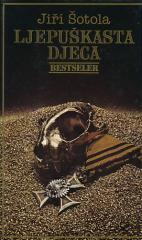
Ljepuškasta djeca

Ljepuškasta djeca

Jiří Šotola

The novel Beautiful Children depicts the world of adolescent rebels in a "re-education" colony - a prison disguised as a school. Written in the spirit of the Prague Spring, the work criticizes the communist system through a dynamic, cinematic narrative.

August Cesarec, 1986.
Croatian. Latin alphabet. Hardcover with dust jacket.
4.82 - 4.84
Družba Isusova

Družba Isusova

Jiří Šotola

The Society of Jesus (1969) by Jiří Šotola, the debut work of the Czech poet, is a historical novel set during the Counter-Reformation, which subtly alludes to contemporary conditions in Czechoslovakia under communism.

Znanje, 1975.
Croatian. Latin alphabet. Hardcover with dust jacket.
2.98 - 4.26
Grumen sunca

Grumen sunca

Zaim Topčić

"A Lump of Sun" (1965) by Zaim Topčić is a novel that depicts broader social and wartime circumstances through the fate of an individual.

Svjetlost, 1965.
Croatian. Latin alphabet. Paperback.
2.50
Ulysses

Ulysses

James Joyce

In James Joyce's Ulysses, we follow a day in the life of Leopold Bloom in Dublin in 1904, through interwoven interior monologues, symbolism, and a parody of the Odyssey, exploring identity, everyday life, and human consciousness.

Penguin Books Ltd, 1992.
English. Latin alphabet. Paperback.
9.42
Sjaj i bijeda kurtizana

Sjaj i bijeda kurtizana

Honore de Balzac

The Splendor and Misery of a Courtesan is part of Balzac's collection The Human Comedy. The novel follows the fate of Lucien de Rubempré, an ambitious young poet, and his relationship with the mysterious Vautrin, an ex-convict, in the world of Parisian de

Kultura, 1952.
Croatian. Latin alphabet. Hardcover.
4.49
Izbor po srodnosti

Izbor po srodnosti

Johann Wolfgang Goethe

The novel follows a married couple, Eduardo and Charlotte, who, after years of separation, are living in harmony again on their estate. When they invite two guests to join them, their emotional connections begin to change.

Novo pokolenje, 1954.
Serbian. Latin alphabet. Hardcover with dust jacket.
8.96