Pinball

Pinball

Jerzy Kosinski

"Pinball" (1982), a novel by Jerzy Kosinski written for George Harrison, is a rock 'n' roll mystery that explores existential crises in a postmodern world. The novel offers an insight into the artistic soul and the struggle with identity in a chaotic worl

The story revolves around two protagonists, Patrick Domostroy and Goddard, and their connection to music and personal demons.

Patrick Domostroy, a once-famous classical composer, is struggling with creative block and now plays at a Bronx nightclub, a place he calls a "pinball joint." His life is changed by his encounter with Andrea, a young music student obsessed with uncovering the identity of Goddard, a mysterious rock superstar who hides his true face and name. Andrea hires Domostroy, using money and sexual attraction, to help her in her quest. As they investigate Goddard's identity, the plot intertwines with themes of sex, violence, and the search for meaning.

Goddard, the other protagonist, lives in the shadow of his own fame, haunted by fears of loss of privacy and death, exacerbated by a tragic incident with a girl he met by chance. The novel uses the metaphor of pinball to depict the chaotic, unpredictable flow of life, where characters, like balls, bounce off events and identities. Domostroy and Goddard face internal conflicts, while Andrea manipulates to achieve her goal.

Kosinski explores postmodernist themes of alienation, false identities, and the decadence of mass culture. Music, as a metaphor for life, connects the characters, but also reveals their inability to find true purpose. The novel ends melodramatically, with a hint of a tragic outcome, reflecting Kosinski's obsession with death and loss.

Translation
Vlado Opačić
Graphics design
Nenad Dogan
Dimensions
18.5 x 11 cm
Pages
336
Publisher
August Cesarec, Zagreb, 1989.
 
Latin alphabet. Paperback.
Language: Croatian.

Multiple copies are available

Copy number 1

Condition:Used, good condition (visible signs of use)
Damages or inconvenience notice:
  • Damaged back
  • Traces of patina

Copy number 2

Condition:Used, excellent condition

Copy number 3

Condition:Used, excellent condition
 

Are you interested in another book? You can search the offer using our search engine or browse books by category.

You may also be interested in these titles

Cockpit

Cockpit

Jerzy Kosinski

The novel Cockpit (1975) is a work by Polish-American writer Jerzy Kosinski. The story follows Tarden, a former agent of the mysterious security agency "Service", who has erased his identity from all files and become a fugitive.

August Cesarec, 1985.
Croatian. Latin alphabet. Paperback.
2.48 - 3.52
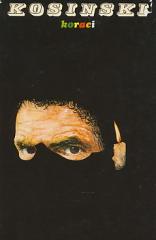
Koraci

Koraci

Jerzy Kosinski

"Steps" is a collection of short stories connected by the character of an unnamed narrator.

Centar za informacije i publicitet (CIP), 1981.
Croatian. Latin alphabet. Hardcover with dust jacket.
2.98
Pustolovine Toma Sawyera

Pustolovine Toma Sawyera

Mark Twain

The Adventures of Tom Sawyer is the first truly realistic children's novel, not only in American but also in world children's literature. Twain's most famous work and a favorite children's book in which the writer described his boyhood experiences.

Nakladni zavod Hrvatske, 1947.
Croatian. Latin alphabet. Hardcover.
16.32
Andrićeva lestvica užasa

Andrićeva lestvica užasa

Svetislav Basara

A Serbian writer known for his satirical novels, Andrić's Ladder of Horrors dissects the Balkan mentality through a parable of Yugo-nostalgia and national myths. The title alludes to Ivo Andrić as a litmus test for criticism – Balkans claim him or reject

24 sata, 2021.
Serbian. Latin alphabet. Paperback.
11.56
Dok ležah na samrti

Dok ležah na samrti

William Faulkner

Faulkner's 1930 novel, a classic example of modernist literature. It is often compared to Joyce's "Ulysses" for its innovative structure, but is more accessible due to its focus on family.

Rad, 1985.
Croatian. Latin alphabet. Paperback.
3.26
Zagrepčanka

Zagrepčanka

Branislav Glumac

Branislav Glumac published a novel without periods or commas in 1974, as the relentless stream of thought of a young rebel. Published in socialist Yugoslavia, the work caused a scandal with its openness and became a classic about generational rebellion.

IROS, 1986.
Croatian. Latin alphabet. Hardcover.
8.22 - 8.24