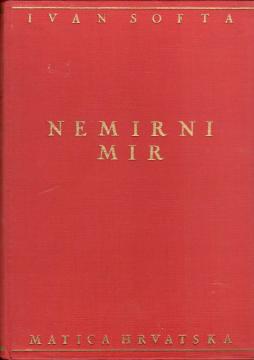
Nemirni mir
Ein rares Buch
Antiquität

Nemirni mir

Ivan Softa

Uneasy Peace (1940) depicts the life of Herzegovinian peasants after World War I, their emigration to Slavonia, the difficult struggle for survival and inner unrest in the apparent peace of the post-war period.

The work is thematically closely related to his previous novel Days of Misery and Hunger (1937) and represents a continuation of the story about the fate of a Herzegovinian peasant in a turbulent period. The plot takes place after the end of World War I. Softa follows the characters who survived the horrors of war and famine, and now seek a better life in Slavonia.

The novel is realistic, in places naturalistic, depicting their new troubles – hard work on someone else's land, social disarray, family dramas, alcoholism and deep inner unrest. Despite the external "peace", the characters carry the traumas of war, poverty and disappointment, which creates an atmosphere of constant tension and existential anxiety.

Critics have pointed out that Uneasy Peace shows the maturation of Softa's talent – ​​the novel is psychologically deeper than the previous one, with a stronger modern overtone and closeness to Hamsun's imagination of hunger and inner evil. Softa is no longer just a painter of the Herzegovinian village, but also a modern storyteller who explores the human psyche in difficult social circumstances.

The style is sharp, direct and unadorned, with a strong Herzegovinian dialect and an authentic depiction of the Dinaric mentality – tough, proud, but also vulnerable. The novel exudes pessimism and a sense of meaninglessness, typical of socially engaged prose of the late 1930s.

Uneasy Peace is considered one of Softa's best works and an important example of Croatian social-realist prose of the interwar period. Due to the author's death on the Way of the Cross in 1945, his work was neglected after the war. Today, the novel is valued as a powerful testimony to the fate of Herzegovina and the difficult post-war years.

The Matica Hrvatska edition is rare.

Maße
20 x 14 cm
Seitenzahl
132
Verlag
Matica hrvatska, Zagreb, 1940.
 
Latein Schrift. Hardcover.
Sprache: Kroatisch.

Weitere Exemplare sind verfügbar

Kopiennummer 1

Zustand:Ungebraucht
Zum Warenkorb hinzugefügt!

Kopiennummer 2

Zustand:Gebraucht, in ausgezeichnetem Zustand
Zum Warenkorb hinzugefügt!

Kopiennummer 3

Zustand:Gebraucht, in gutem Zustand (Gebrauchsspuren)
Nachteile/Unannehmlichkeiten:
  • Tragovi patine
  • Pohabane korice
Zum Warenkorb hinzugefügt!
 

Interessieren Sie sich für ein anderes Buch? Sie können das Angebot über unsere Suchmaschine suchen und finden oder Bücher nach Kategorien durchsuchen.

Diese Titel könnten Sie auch interessieren

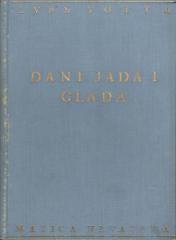
Dani jada i glada

Dani jada i glada

Ivan Softa

Roman Ivana Softe o životu hercegovačkog sela tijekom Prvog svjetskog rata. Realistički i potresno prikazuje bijedu, glad, bolesti, ratne mobilizacije i patnje seljaka, osuđujući rat i društvene nepravde.

Matica hrvatska, 1937.
Kroatisch. Latein Schrift. Hardcover.
9,72 - 11,34
Rudnik čvaraka

Rudnik čvaraka

Tomislav Šovagović

The debut work of Croatian writer Tomislav Šovagović, awarded the Josip and Ivan Kozarac Award in 2012, is a dedication to Slavonia – the region of his childhood that the author, born in Dalmatia, observes with foreign but tender eyes.

Mozaik knjiga, 20112.
Kroatisch. Latein Schrift. Taschenbuch.
11,56
Bilješka o piscu: Neljubavni roman

Bilješka o piscu: Neljubavni roman

Julijana Matanović

A Writer's Note is the first bestseller by beloved Croatian author Julijana Matanović. A hit since its publication, the novel reminds us that the past cannot be erased, only understood.

Mozaik knjiga, 2002.
Kroatisch. Latein Schrift. Taschenbuch.
6,38
Dvije pripovijetke: Nezasitnost i bijeda / Iz velegradskog podzemlja

Dvije pripovijetke: Nezasitnost i bijeda / Iz velegradskog podzemlja

Vjenceslav Novak
Školska knjiga, 1974.
Kroatisch. Latein Schrift. Taschenbuch.
1,03 - 1,46
Malo prije svega odavno smo

Malo prije svega odavno smo

Goran Rem

A Little Before Everything, Long Ago We Are is the eleventh collection of poetry by Goran Rem (b. 1958, Osijek), a poet, essayist, literary historian, and member of the Quorum generation in Croatian literature.

MeandarMedia, 2024.
Kroatisch. Latein Schrift. Taschenbuch mit Einband.
12,34
Moj zagrebački rukopis

Moj zagrebački rukopis

Zvonimir Milčec

Milčec is still just as in love with the city. He conquers it just as youthfully. The siege of Zagreb has made no one smaller. The city grows and the conqueror continues to conquer the unconquerable.

VBZ, 2007.
Kroatisch. Latein Schrift. Hardcover.
14,98