Nemirni mir
Antique
Rare book

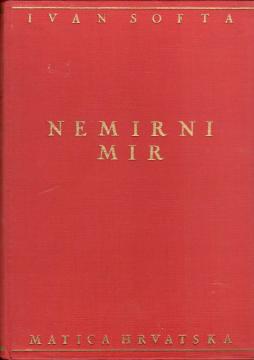
Nemirni mir

Ivan Softa

Uneasy Peace (1940) depicts the life of Herzegovinian peasants after World War I, their emigration to Slavonia, the difficult struggle for survival and inner unrest in the apparent peace of the post-war period.

The work is thematically closely related to his previous novel Days of Misery and Hunger (1937) and represents a continuation of the story about the fate of a Herzegovinian peasant in a turbulent period. The plot takes place after the end of World War I. Softa follows the characters who survived the horrors of war and famine, and now seek a better life in Slavonia.

The novel is realistic, in places naturalistic, depicting their new troubles – hard work on someone else's land, social disarray, family dramas, alcoholism and deep inner unrest. Despite the external "peace", the characters carry the traumas of war, poverty and disappointment, which creates an atmosphere of constant tension and existential anxiety.

Critics have pointed out that Uneasy Peace shows the maturation of Softa's talent – ​​the novel is psychologically deeper than the previous one, with a stronger modern overtone and closeness to Hamsun's imagination of hunger and inner evil. Softa is no longer just a painter of the Herzegovinian village, but also a modern storyteller who explores the human psyche in difficult social circumstances.

The style is sharp, direct and unadorned, with a strong Herzegovinian dialect and an authentic depiction of the Dinaric mentality – tough, proud, but also vulnerable. The novel exudes pessimism and a sense of meaninglessness, typical of socially engaged prose of the late 1930s.

Uneasy Peace is considered one of Softa's best works and an important example of Croatian social-realist prose of the interwar period. Due to the author's death on the Way of the Cross in 1945, his work was neglected after the war. Today, the novel is valued as a powerful testimony to the fate of Herzegovina and the difficult post-war years.

The Matica Hrvatska edition is rare.

Dimensions
20 x 14 cm
Pages
132
Publisher
Matica hrvatska, Zagreb, 1940.
 
Latin alphabet. Hardcover.
Language: Croatian.

Two copies are available

Copy number 1

Condition:Unused

Copy number 2

Condition:Used, excellent condition
 

Are you interested in another book? You can search the offer using our search engine or browse books by category.

You may also be interested in these titles

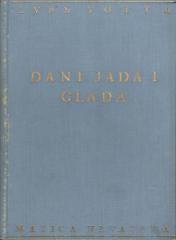
Dani jada i glada

Dani jada i glada

Ivan Softa

A novel by Ivan Softa about life in a Herzegovinian village during World War I. It realistically and poignantly depicts misery, hunger, disease, war mobilization, and the suffering of peasants, condemning war and social injustices.

Matica hrvatska, 1937.
Croatian. Latin alphabet. Hardcover.
9.72 - 11.34
Muškarci imaju P.

Muškarci imaju P.

Darko Pernjak

In this collection of stories, Pernjak deals with quite ordinary, everyday situations, but finds something new and original in them. These are thematically diverse stories that center on interpersonal relationships.

Vošicki j.d.o.o., 2022.
Croatian. Latin alphabet. Paperback.
6.62
Made in U.S.A.

Made in U.S.A.

Goran Tribuson

Imagine Zagreb in the 1980s, where behind the gray facades of apartment buildings lies a dream world of the far West – Hollywood, freedom and endless possibilities. Tribuson, a master of Croatian prose, here combines genres into one fluid story that bites

Znanje, 1986.
Croatian. Latin alphabet. Hardcover with dust jacket.
5.724.29
Sve ča mi rabi ovega prolića

Sve ča mi rabi ovega prolića

Evelin Rudan

Everything I Need This Spring is the first solo poetry collection by Evelina Rudan, a poet and scholar from Pula and Zagreb (born 1971). The book represents a significant contribution to contemporary Istrian Chakavian lyric poetry.

Naklada MD, 2000.
Croatian. Latin alphabet. Paperback.
5.32
Rudnik čvaraka

Rudnik čvaraka

Tomislav Šovagović

The debut work of Croatian writer Tomislav Šovagović, awarded the Josip and Ivan Kozarac Award in 2012, is a dedication to Slavonia – the region of his childhood that the author, born in Dalmatia, observes with foreign but tender eyes.

Mozaik knjiga, 20112.
Croatian. Latin alphabet. Paperback.
11.56
Tirena

Tirena

Marin Držić

Pastoral drama (comedy) in five acts, written in double-rhymed twelve-line stanzas (with eight-line stanzas in the lyrical parts), the oldest preserved play by Držić (premiered in 1548 in Dubrovnik, printed in 1551 in Venice).

Matica hrvatska, 1948.
Croatian. Latin alphabet. Hardcover.
7.36