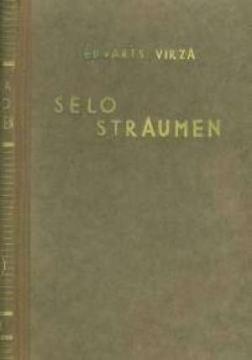
Selo Straumen: kronika lotiškog imanja
Antikvitet

Selo Straumen: kronika lotiškog imanja

Edvarts Virza

In the novel Straumen Village, Edvarts Virza depicts the idealized life of a Latvian village through the cycle of the seasons, emphasizing the collective, tradition, and harmony of man with nature.

Edvarts Virza in his work The Village of Straumen (1933) creates one of the most recognizable works of Latvian interwar literature, which can be understood as a poetic chronicle of idealized rural life.

For the reader unfamiliar with the Latvian literary tradition, it is important to emphasize that Straumēni does not function as a classic novel with a single protagonist and a clear plot line, but as a lyrical-epic depiction of a rural community. The work is often described as a rural epic, because the focus is not on the individual but on the collective – the family and the peasants living in harmony with natural cycles.

The plot is organized around the change of seasons, which determines the rhythm of life: spring brings the beginning of work and renewal, summer an intensive agricultural cycle, autumn the harvest and a sense of fulfillment, and winter a retreat into an enclosed, family space and reflection. This builds the idea of ​​a stable, almost archetypal order in which man, land and tradition are interconnected.

In a broader cultural context, the work was created in a period when Latvian literature strongly affirmed national identity and rural values, often idealizing the village as a bearer of moral and cultural stability. Straumen Village is therefore read not only as a depiction of rural life, but also as a symbolic construction of national space and collective memory.

Stylistically, Virza uses highly stylized, rich and rhythmic language, close to poetry, which gives everyday village chores a monumental, almost mythical dimension. It is this combination of realism of details and idealization that makes the work one of the canonical texts of 20th-century Latvian literature.

Naslov originala
Straumēni
Prevod
Ivan Esih
Dimenzije
18 x 13 cm
Broj strana
212
Izdavač
Suvremena biblioteka, Zagreb, 1943.
 
Latinica. Tvrde korice.
Jezik: Hrvatski.

Jedan primerak je u ponudi

Stanje:Korišćeno, u vrlo dobrom stanju
Oštećenja / nepogodnosti:
  • Traces of patina
Dodato u korpu!
 

Zanima Vas i neka druga knjiga? Možete pretražiti našu ponudu pomoću pretrage ili prelistati knjige po kategorijama.

Možda će Vas zanimati i ovi naslovi

Tako svršava

Tako svršava

Zvonimir Remeta

A novel that thematizes the family complex, tense and unhealthy relationship between people, especially between parents and children.

Matica hrvatska, 1943.
Hrvatski. Latinica. Broširano.
6,42
Sadioci luka

Sadioci luka

Anton Ingolič

"Sadioci luka" is a novel by Slovenian writer Anton Ingolič, published in 1974. The work thematizes agrarian reform and collectivization in rural areas, showing the challenges faced by peasants during this process.

Spektar, 1974.
Hrvatski. Latinica. Tvrde korice.
1,82 - 3,64
U registraturi

U registraturi

Ante Kovačić

The novel In the Registry is a key work by Ante Kovačić and the most important novel of Croatian realism. In this work, Kovačić addresses the problem of the transition from the peasant class to the gentry class.

Spektar, 1974.
Hrvatski. Latinica. Tvrde korice.
5,484,11 - 5,62
Krvava arena

Krvava arena

Vicente Blasco Ibanez

The Bloody Arena (1908) is a naturalistic novel about the rise and fall of bullfighter Juan Gallardo. A poor young man becomes a famous matador, but is destroyed by love, vice, fear, and tragedies in the arena – a critique of Spanish bullfighting and soci

Naprijed, 1984.
Hrvatski. Latinica. Tvrde korice s omotom.
4,76
Na selu

Na selu

Ivan Potrč

"In the Countryside" is a novel by Slovenian writer Ivan Potrč, published in 1974. The work deals with the lives of Slovenian peasants, depicting their everyday challenges and social changes in a rural community.

Spektar, 1974.
Hrvatski. Latinica. Tvrde korice.
3,26
Mati

Mati

Maksim Gorki

Maxim Gorky's novel "Mother" was published in 1906 and is one of the key works of Russian social realism. The work depicts the awakening of the working class in Russia through characters and events that emphasize social injustices and the need for revolut

Svjetlost, 1975.
Hrvatski. Latinica. Tvrde korice.
4,26