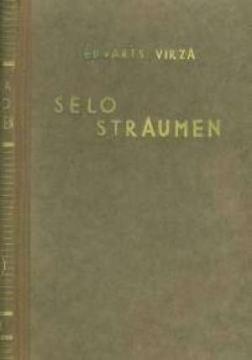
Selo Straumen: kronika lotiškog imanja
Antiquität

Selo Straumen: kronika lotiškog imanja

Edvarts Virza

In the novel Straumen Village, Edvarts Virza depicts the idealized life of a Latvian village through the cycle of the seasons, emphasizing the collective, tradition, and harmony of man with nature.

Edvarts Virza in his work The Village of Straumen (1933) creates one of the most recognizable works of Latvian interwar literature, which can be understood as a poetic chronicle of idealized rural life.

For the reader unfamiliar with the Latvian literary tradition, it is important to emphasize that Straumēni does not function as a classic novel with a single protagonist and a clear plot line, but as a lyrical-epic depiction of a rural community. The work is often described as a rural epic, because the focus is not on the individual but on the collective – the family and the peasants living in harmony with natural cycles.

The plot is organized around the change of seasons, which determines the rhythm of life: spring brings the beginning of work and renewal, summer an intensive agricultural cycle, autumn the harvest and a sense of fulfillment, and winter a retreat into an enclosed, family space and reflection. This builds the idea of ​​a stable, almost archetypal order in which man, land and tradition are interconnected.

In a broader cultural context, the work was created in a period when Latvian literature strongly affirmed national identity and rural values, often idealizing the village as a bearer of moral and cultural stability. Straumen Village is therefore read not only as a depiction of rural life, but also as a symbolic construction of national space and collective memory.

Stylistically, Virza uses highly stylized, rich and rhythmic language, close to poetry, which gives everyday village chores a monumental, almost mythical dimension. It is this combination of realism of details and idealization that makes the work one of the canonical texts of 20th-century Latvian literature.

Titel des Originals
Straumēni
Übersetzung
Ivan Esih
Maße
18 x 13 cm
Seitenzahl
212
Verlag
Suvremena biblioteka, Zagreb, 1943.
 
Latein Schrift. Hardcover.
Sprache: Kroatisch.

Angeboten wird ein Exemplar

Zustand:Gebraucht, in sehr gutem Zustand
Nachteile/Unannehmlichkeiten:
  • Traces of patina
Zum Warenkorb hinzugefügt!
 

Interessieren Sie sich für ein anderes Buch? Sie können das Angebot über unsere Suchmaschine suchen und finden oder Bücher nach Kategorien durchsuchen.

Diese Titel könnten Sie auch interessieren

Ili jesmo ili nismo

Ili jesmo ili nismo

Slavko Kolar

Either We Are or We Are Not (1933) is Slavko Kolar's most famous collection of short stories. With a satirical and warm sense of humor, Kolar depicts the life of the Croatian village and the common man in interwar Yugoslavia – electoral fraud, bureaucracy

Matica hrvatska, 1933.
Kroatisch. Latein Schrift. Hardcover.
9,26
Podgorka

Podgorka

Vjenceslav Novak

Podgorka follows the life and fate of a young woman from the poor Podgorka region. The novel realistically depicts the difficult social conditions, customs, poverty and struggle for dignity in the Senj hinterland in the 19th century.

Minerva nakladna knjižara, 1932.
Kroatisch. Latein Schrift. Hardcover.
5,72
Veliko proljeće

Veliko proljeće

Stjepko Vrtar

The Great Spring (1933) depicts the awakening and rebirth of the Croatian village and the common man in the interwar period – a symbolic depiction of the national and social spring, the peasant movement, and the personal maturation of the main character.

Matica hrvatska, 1933.
Kroatisch. Latein Schrift. Hardcover.
7,26
Prezir / Agostino

Prezir / Agostino

Alberto Moravia

In "Contempt," screenwriter Riccardo obsessively searches for the reason why his wife Emilia despises and alienates him. In "Agostino," a 13-year-old boy on a summer vacation with his mother experiences a sexual awakening and perceives his mother as a wom

Otokar Keršovani, 1966.
Kroatisch. Latein Schrift. Hardcover.
3,86
Konformist

Konformist

Alberto Moravia

Marcello Clerici, obsessed with normality after a traumatic childhood and a homosexual attack, becomes a fascist bureaucrat. He marries the average Giulia, and on their "honeymoon" in Paris, he is assigned to kill a former professor, anti-fascist Quadri.

Otokar Keršovani, 1966.
Kroatisch. Latein Schrift. Taschenbuch.
4,96
Baselska zvona

Baselska zvona

Louis Aragon

The novel follows three women: Diane, a noblewoman; Catherine Simonidzé, a feminist; and the real Clara Zetkin, a communist. Through their destinies, the crisis of bourgeois society, women's emancipation, and the path to communism are depicted.

Kultura, 1946.
Serbisch. Latein Schrift. Hardcover.
5,76