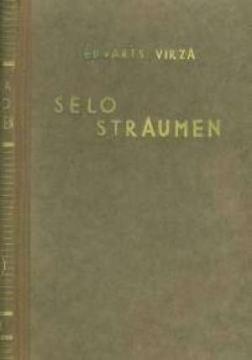
Selo Straumen: kronika lotiškog imanja
Antique

Selo Straumen: kronika lotiškog imanja

Edvarts Virza

In the novel Straumen Village, Edvarts Virza depicts the idealized life of a Latvian village through the cycle of the seasons, emphasizing the collective, tradition, and harmony of man with nature.

Edvarts Virza in his work The Village of Straumen (1933) creates one of the most recognizable works of Latvian interwar literature, which can be understood as a poetic chronicle of idealized rural life.

For the reader unfamiliar with the Latvian literary tradition, it is important to emphasize that Straumēni does not function as a classic novel with a single protagonist and a clear plot line, but as a lyrical-epic depiction of a rural community. The work is often described as a rural epic, because the focus is not on the individual but on the collective – the family and the peasants living in harmony with natural cycles.

The plot is organized around the change of seasons, which determines the rhythm of life: spring brings the beginning of work and renewal, summer an intensive agricultural cycle, autumn the harvest and a sense of fulfillment, and winter a retreat into an enclosed, family space and reflection. This builds the idea of ​​a stable, almost archetypal order in which man, land and tradition are interconnected.

In a broader cultural context, the work was created in a period when Latvian literature strongly affirmed national identity and rural values, often idealizing the village as a bearer of moral and cultural stability. Straumen Village is therefore read not only as a depiction of rural life, but also as a symbolic construction of national space and collective memory.

Stylistically, Virza uses highly stylized, rich and rhythmic language, close to poetry, which gives everyday village chores a monumental, almost mythical dimension. It is this combination of realism of details and idealization that makes the work one of the canonical texts of 20th-century Latvian literature.

Original title
Straumēni
Translation
Ivan Esih
Dimensions
18 x 13 cm
Pages
212
Publisher
Suvremena biblioteka, Zagreb, 1943.
 
Latin alphabet. Hardcover.
Language: Croatian.

One copy is available

Condition:Used, very good condition
Damages or inconvenience notice:
  • Traces of patina
 

Are you interested in another book? You can search the offer using our search engine or browse books by category.

You may also be interested in these titles

Graditelji života

Graditelji života

Marin Franičević

A collection of revolutionary and socially engaged poetry by Marin Franičević. The poems celebrate the partisan struggle, the building of socialism, work, the collective, and the future, filled with optimism and faith in the "builders of a new life."

Kultura, 1950.
Croatian. Latin alphabet. Hardcover.
12.34
Tajna zelene ptice

Tajna zelene ptice

Luis Coloma

The Secret of the Green Bird (1910) is a novel by Spanish writer and Jesuit Luis Coloma, an author also known for the story of Ratoncito Pérez, about a young man from a Spanish aristocratic family who grew up without a mother under the influence of a domi

Hrvatsko književno društvo Sv. Jeronima, 1928.
Croatian. Latin alphabet. Hardcover.
4.72
Informator

Informator

Vjenceslav Novak

Informator (1894) is a shorter prose work by Vjenceslav Novak, edited by Slavko Ježić (the third volume of Collected Works). It is one of Novak's most socially engaged texts and is typical of his realistic approach.

Minerva nakladna knjižara, 1932.
Croatian. Latin alphabet. Hardcover.
3.24 - 5.46
Veliko proljeće

Veliko proljeće

Stjepko Vrtar

The Great Spring (1933) depicts the awakening and rebirth of the Croatian village and the common man in the interwar period – a symbolic depiction of the national and social spring, the peasant movement, and the personal maturation of the main character.

Matica hrvatska, 1933.
Croatian. Latin alphabet. Hardcover.
7.26
Lady Chatterley i njezin ljubavnik

Lady Chatterley i njezin ljubavnik

David Herbert Lawrence

A novel about young Constance Chatterley, who, while married to a paralyzed nobleman, finds passionate love and a sexual awakening with the poacher Oliver Mellors. A classic of modern literature and a powerful critique of English class society.

Naklada Binoza, 1937.
Croatian. Latin alphabet. Hardcover with dust jacket.
4.26
Dinamit: Povijest klasnog nasilja u Americi

Dinamit: Povijest klasnog nasilja u Americi

Louis Adamić

The book documents a century of violence in the American labor movement — from 19th-century mining strikes to bombings and clashes with police — and exposes the brutal background to America's "class war."

Naklada Binoza, 1933.
Croatian. Latin alphabet. Hardcover with dust jacket.
7.245.07