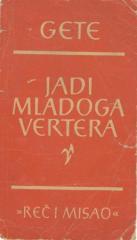
Patnje mladog Werthera

Patnje mladog Werthera

Johann Wolfgang Goethe

At one time, Mrs. de Staßl, who was extremely influential, said of Goethe's "Werther" that it was "a work that has killed more men than the most beautiful woman could."

Goethe's story about the love of a young man for his friend's fiancee and later his wife, with a tragic ending and all soaked in sentimentality, through which a protest against social discrimination also runs, resonated among contemporaries in different ways.

Germany, and very soon the entire cultural world that received translations, is suffocating in streams of tears, literature, painting, music are choked with the motifs of Werther, and the general public imitates Goethe's heroes in everything, and even in the way they dress. Men thus begin to wear in reality (like Werther in the novel) a blue riding coat with brass buttons, a yellow waistcoat and trousers, and high boots with brown edges.

This fashion came at that time from England, and was a kind of protest against the frivolity and stiffness of Rococo. As Goethe himself wore these clothes when he arrived in Weimar, the whole court began to dress like that, including Duke Karl August, who used to call other people Goethe's monkeys. The women of course followed Lotta's fashion line: a long white dress with a high waist, short sleeves and a plunging neckline, with bright red ribbons on it.

In the 19th century, the Croatian cultural audience received Goethe's works mainly in the original language, which explains the relatively late publication of the translation. So "Ladies of Young Werther" were first printed in 1931 in the translation of M. Cihlar Nehajev, but since then several editions with different translators have appeared.

Among them are I. V. Lalić, I. Hergešić, S. Slamnig, Vera Čičin-Šain, and the latest translation is by S. Mutak, published a few years ago.

Naslov izvornika
Die Leiden des jungen Werthers
Prijevod
Vera Čičin-Šain
Dimenzije
21 x 13 cm
Broj strana
113
Nakladnik
Večernji list, Zagreb, 2004.
 
Latinica. Tvrde korice s ovitkom.
Jezik: Hrvatski.
ISBN
978-9-53716-150-7

Nema primjeraka u ponudi

Poslednji primjerak je nedavno prodan.
 

Zanima Vas i neka druga knjiga? Možete pretražiti našu ponudu pomoću tražilice ili prelistati knjige po kategorijama.

Možda će Vas zanimati i ovi naslovi

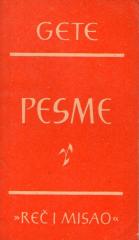
Pesme

Pesme

Johann Wolfgang Goethe
Izdavačko preduzeće "Rad", 1964.
Srpski. Latinica. Broširano.
2,50 - 2,52
Egmont : tragedija u pet činova

Egmont : tragedija u pet činova

Johann Wolfgang Goethe
Matica hrvatska, 1942.
Hrvatski. Latinica. Tvrde korice.
15,42
Jadi mladoga Vertera

Jadi mladoga Vertera

Goethe's masterpiece of an epistolary novel from 1774 (revised in 1787), pivotal to the Sturm und Drang movement, caused a cultural upheaval in Europe – a wave of suicides, "Wertherism" and the imitation of heroes in fashion and sentiment.

Nolit, 1966.
Srpski. Latinica. Tvrde korice.
4,88
Andrićeva lestvica užasa

Andrićeva lestvica užasa

Svetislav Basara

A Serbian writer known for his satirical novels, Andrić's Ladder of Horrors dissects the Balkan mentality through a parable of Yugo-nostalgia and national myths. The title alludes to Ivo Andrić as a litmus test for criticism – Balkans claim him or reject

24 sata, 2021.
Srpski. Latinica. Broširano.
11,56
Deobe 1-3

Deobe 1-3

Dobrica Ćosić

This work, awarded the NIN Prize for that year, is considered one of the most significant in Serbian literature after World War II.

Prosveta, 1961.
Srpski. Ćirilica. Tvrde korice s ovitkom.
Knjiga se sastoji od tri toma
11,42
Štefica Cvek u raljama života

Štefica Cvek u raljama života

Dubravka Ugrešić

Do you like "lovelies"? Whatever you think about them, you'll enjoy this superb pastiche of trivial romance novels.

Mladinska knjiga, 1990.
Hrvatski. Latinica. Tvrde korice s ovitkom.
4,94