Životinjska farma
Rijetka knjiga

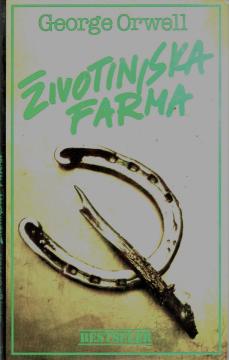
Životinjska farma

George Orwell

"Animal Farm" is a short satirical dystopian novel by British writer George Orwell (Eric Arthur Blair), one of the most influential works of the 20th century. Orwell uses a simple, fairy-tale style to criticize totalitarianism and government corruption.

In George Orwell's allegorical novel Animal Farm (1945), the animals at Manor Farm revolt against man and drive out Farmer Jones. They establish an equal society under the motto "All animals are equal". Pig Napoleon takes over, changes the rules and turns the farm into a dictatorship, where "All animals are equal, but some are more equal".

The plot is an allegory of the October Revolution and the rise of Stalinism in the USSR. The animals on the English farm Manor Farm, led by the old sow Major (symbol of Marx/Lenin), rebel against the cruel farmer Jones (Czarism). After the revolution, the farm becomes the Animal Farm, and the seven commandments of Animalism ("All animals are equal", "Whatever walks on two legs is the enemy", etc.) become the basis of the new society.

Two fillies – Snowball (Trotsky) and Napoleon (Stalin) – are fighting for leadership. Napoleon, with the help of dogs (secret police), expels Snowball and takes absolute power. He gradually changes the orders (e.g. "Animals are not allowed to sleep in bed" → "no sheets"), lives luxuriously, trades with people and completely betrays the ideals of the revolution. In the final scene, the animals no longer distinguish pigs from humans - the dictatorship is complete.

The book was rejected by several publishers due to its criticism of the USSR during World War II, but it became a classic of anti-Stalinist literature. It was popular in post-war Yugoslavia, often interpreted as a criticism of Stalinism and bureaucratic socialism. Today it is read as a universal parable about power, propaganda and the betrayal of idealism. One of the most important works of political satire, along with 1984.

Naslov izvornika
Animal Farm: A Fairy Story
Prijevod
Vladimir Roksandić
Urednik
Zdravko Židovec
Naslovnica
Nenad Dogan
Dimenzije
19 x 12 cm
Broj strana
109
Nakladnik
August Cesarec, Zagreb, 1985.
 
Latinica. Tvrde korice s ovitkom.
Jezik: Hrvatski.

Jedan primjerak je u ponudi

Stanje:Korišteno, u odličnom stanju
Dodano u košaricu!
 

Zanima Vas i neka druga knjiga? Možete pretražiti našu ponudu pomoću tražilice ili prelistati knjige po kategorijama.

Možda će Vas zanimati i ovi naslovi

Mali mitovi

Mali mitovi

Stanisław Jerzy Lec
Književna zajednica Novog Sada, 1986.
Hrvatski. Latinica. Broširano.
5,22
Meet Mr Mulliner

Meet Mr Mulliner

P. G. Wodehouse

Meet Mr. Mulliner is a collection of short stories by P. G. Wodehouse.

Penguin Books Ltd, 1962.
Engleski. Latinica. Broširano.
8,77
Što je muškarac bez brkova: humoristički roman

Što je muškarac bez brkova: humoristički roman

Ante Tomić

Tomićs Roman „Was ist ein Mann ohne Schnurrbart?“ wurde bei seiner Erstveröffentlichung im Jahr 2000 sofort ein Bestseller und erlebte in den darauffolgenden Jahren eine Reihe von Neuauflagen, Dramatisierungen und eine Verfilmung. Erstausgabe.

Hena Com, 2000.
Hrvatski. Latinica. Broširano.
15,24
Bilježnica Robija K.

Bilježnica Robija K.

Viktor Ivančić

Robis Notizbuch von K. Viktor Ivančić ist ein satirisches Buch in Form eines Tagebuchs des achtjährigen Jungen Robi, durch dessen scheinbar naive Perspektive die sozialen und politischen Absurditäten Kroatiens in den frühen 1990er Jahren enthüllt werden.

Feral Tribune, 1994.
Hrvatski. Latinica. Broširano.
22,36
Satire

Satire

Radoje Domanović
Zora, 1968.
Srpski. Latinica. Broširano.
2,74
Žene, bajke, kraljice

Žene, bajke, kraljice

Nada Gašić, Julijana Adamović, Nataša Govedić, Vera Vujović, Lada Žigo, Jadranka Pintarić, Jadran...

Žene, bajke, kraljice – prva je u nizu zbirki priča namijenjenih odrasloj publici u kojoj je devet hrvatskih književnica odlučilo ozvučiti ženske likove iz bajki.

Kreativna mreža, 2021.
Hrvatski. Latinica. Broširano.
9,987,98