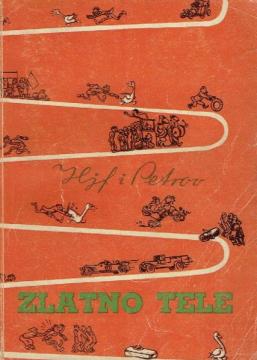
Zlatno tele
Retka knjiga

Zlatno tele

Ilja Iljf, Jevgenij Petrov

The Golden Calf (1931) is a brilliant satirical picaresque adventure, a sequel to the legendary 12 Chairs, where the great schemer Ostap Bender returns in full glory – charming, cynical, irredeemably cunning and always one step ahead of everyone else.

The story takes place in the Soviet Union in the late 1920s, during the NEP and the beginning of the five-year plan, when old Russia was mixing with new socialist dreams. Ostap Bender, who survived in the first novel (although he did not receive millions), now sets his sights on a new target: the secret treasury of businessman Alexander Koreiko, one of the rare Soviet millionaires who made his fortune through smuggling, bribery and manipulation, and lives modestly as an ordinary accountant. Bender gathers a team of "lieutenant's sons" - a motley crew of swindlers, dreamers and opportunists - and sets off on a grand chase across the entire USSR: from Moscow, through Kharkov, over the railways, to the Black Sea and Central Asia.

The novel is full of hilarious episodes: fake film footage, the "Antelope-Gnu" car that becomes a legend, encounters with bureaucrats, journalists, the police and ordinary people. Bender excels with his aphorisms ("Don't bother, I'll tell you the truth - I'm a great schemer!", "The rich are poor people"), ridiculing the corruption, bureaucracy, greed and hypocrisy of the new society. But beneath the humor lies a bitter note: Ostap is a tragic character - a brilliant swindler who dreams of "Rio de Janeiro" (a symbol of freedom and wealth), but realizes that there is no place for an individual like him in the Soviet Union.

Ilf and Petrov write quickly, humorously, with Odessa charm and a keen eye for the absurd - the novel is full of quotations that have entered the language ("How is life on the Riva?", "Your telegram received, but not understood"). It is a satire on Soviet reality, but also a universal comedy about human greed and illusions.

Naslov originala
Золотой телёнок
Prevod
Stjepan Kranjčević
Dimenzije
20 x 14 cm
Broj strana
355
Izdavač
Kultura, Zagreb, 1946.
 
Latinica. Tvrde korice s omotom.
Jezik: Hrvatski.

Jedan primerak je u ponudi

Stanje:Korišćeno, u vrlo dobrom stanju
Oštećenja / nepogodnosti:
  • The cover is missing
Dodato u korpu!
 

Zanima Vas i neka druga knjiga? Možete pretražiti našu ponudu pomoću pretrage ili prelistati knjige po kategorijama.

Možda će Vas zanimati i ovi naslovi

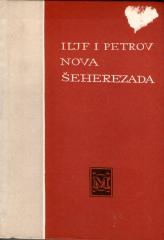
Nova Šeherezada

Nova Šeherezada

Ilja Iljf, Jevgenij Petrov
Grafički zavod Hrvatske (GZH), 1964.
Srpski. Latinica. Tvrde korice.
4,99
Dvanaest stolica

Dvanaest stolica

Ilja Iljf, Jevgenij Petrov

The main character of the novel is the ingenious swindler Ostap Bender, who this time is looking for diamonds in one of 12 upholstered chairs blown up across the Soviet Union.

Nolit, 1969.
Srpski. Latinica. Broširano.
3,98
12 stolica

12 stolica

Ilja Iljf, Jevgenij Petrov

A satirical search for hidden treasure in post-revolutionary Russia. Former nobleman Ippolit Matveyevich Vorobyaninov and con artist Ostap Bender chase after valuables, exposing the greed and absurdities of Soviet society.

Šareni dućan, 2013.
Hrvatski. Latinica. Tvrde korice.
16,54
Gargantua i Pantagruel

Gargantua i Pantagruel

François Rabelais

Rabelais' masterpiece, a five-book novel cycle that follows the adventures of the giant Gargantua and his son Pantagruel. Vinaver, known for his linguistic virtuosity, masterfully conveys Rabelais's lavish humor, juicy swear words, and layered wordplay.

Kultura, 1950.
Srpski. Ćirilica. Tvrde korice.
Knjiga se sastoji od dva toma
11,34
Grafiti & co

Grafiti & co

Vedran Vrsalović

500+ graffiti

Grafiti & co, 2006.
Hrvatski. Latinica. Broširano.
4,98
Dundo Maroje / Skup / Novela od Stanca

Dundo Maroje / Skup / Novela od Stanca

Marin Držić

Dundo Maroje and Novela od Stanac are masterpieces of the greatest Croatian renaissance comedy writer - Marin Držić. At the same time, these are his most famous comedies, which belong to the very top of Croatian Renaissance literature.

Školska knjiga, 1985.
Hrvatski. Latinica. Tvrde korice.
3,26