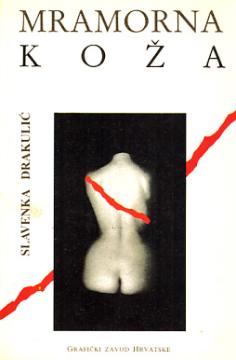
Mramorna koža

Mramorna koža

Slavenka Drakulić

The novel, written in the first person, describes the complex, distant relationship between a sculptor (the narrator) and her mother. The main characters are the sculptor, a beauty mother obsessed with purity and bodily blemishes, and a stepfather, who en

The story begins in the present: a sculptor models a marble sculpture of her mother's body called "Marble Skin", a symbol of the cold and emptiness beneath the surface. The mother, after eight years of separation, sees the photo in a magazine and attempts suicide, forcing her daughter to return and take care of her. Through memories, we discover the past: a childhood without a father (who committed suicide when her daughter was three), the mother's obsession with cleanliness (her first period and bra as traumas), the arrival of her stepfather when the daughter is 14. The stepfather sexually abuses her daughter, and the mother ignores this, choosing him over her daughter, which gives rise to hatred, love and jealousy.

The climax is an emotional conflict: the daughter fetishizes her mother's body, feels like an extension of it, but wants to destroy it. The encounter after years remains superficial - about health and money, not about pain. The daughter recalls her mother's men, puberty, and attempts to "touch" her mother through art and the senses (sight, touch, smell, taste, hearing). The mother, obsessed with youth and afraid of aging, is herself a victim of trauma.

Themes include the female body as a source of harm and lust, incest and abuse, maternal unreturnability, the shame and guilt of growing up into a woman, and the destructive power of sexuality. The novel is claustrophobic, sensual, with an emphasis on silence and the unspoken, exploring how trauma shapes identity.

Urednik
Nenad Popović
Naslovnica
Sanja Iveković
Dimenzije
20 x 14 cm
Broj strana
157
Izdavač
Grafički zavod Hrvatske (GZH), Zagreb, 1989.
 
Tiraž: 5.000 primeraka
 
Latinica. Broširano.
Jezik: Hrvatski.
ISBN
8-63-990238-0

Jedan primerak je u ponudi

Stanje:Korišćeno, u odličnom stanju
Dodato u korpu!
 

Zanima Vas i neka druga knjiga? Možete pretražiti našu ponudu pomoću pretrage ili prelistati knjige po kategorijama.

Možda će Vas zanimati i ovi naslovi

Život u pričama

Život u pričama

Ivana Bodrožić, Slavenka Drakulić, Rujana Jeger, Tisja Kljaković Braić, Maša Kolanović, Julijana ...

Strong women for strong women

Profil Knjiga, 2021.
Hrvatski. Latinica. Broširano.
6,22
Kao da me nema

Kao da me nema

Slavenka Drakulić

Slavenka Drakulićs Roman ist eine erschütternde Geschichte über Massenvergewaltigungen während des Bosnienkrieges. Er wurde bisher in sechzehn Ländern veröffentlicht und kürzlich in einer irisch-schwedisch-mazedonischen Koproduktion unter demselben Titel

Feral Tribune, 1999.
Hrvatski. Latinica. Broširano.
16,32
Stari obiteljski vrt

Stari obiteljski vrt

Giorgio Bassani

Giorgio Bassani's Italian historical novel, published in 1962, chronicles the relationship between the narrator and the children of the Finzi-Contini family from the rise of Benito Mussolini to the beginning of World War II.

Mladost, 1964.
Hrvatski. Latinica. Tvrde korice s omotom.
4,22 - 4,28
Eugenija Grande

Eugenija Grande

Honore de Balzac

"Eugénie Grandet" (1833), part of Balzac's Human Comedy, is a realistic novel that explores greed, family relationships, and the sacrifices of love in provincial French society.

Svjetlost, 1981.
Hrvatski. Latinica. Tvrde korice.
3,88
Više ih umire od tuge

Više ih umire od tuge

Saul Bellow

The story is told through the eyes of narrator Kenneth Trachtenberg, a 35-year-old assistant professor of Russian literature, born in Paris, but now living in the Midwest of the USA.

Veselin Masleša, 1990.
Hrvatski. Latinica. Tvrde korice s omotom.
5,98
Frederika

Frederika

Roger Vailland
Bratstvo-Jedinstvo, 1965.
Srpski. Latinica. Tvrde korice.
7,98