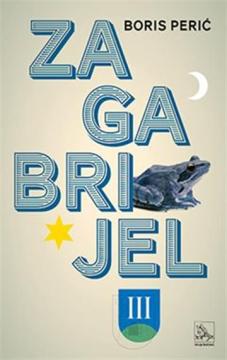
Zagabrijel

Zagabrijel

Boris Perić

The third part brings to an end this painful and dark story in which the unfortunate Nesi Hensu, better known as the Zagreb mummy, will find herself involved, neither guilty nor obliged.

With Zagabrije, the first part of this unusual trilogy, Boris Perić attracted the readership by creating a skilfully told criminal story, in which an old Zagreb secret society with nefarious intentions, a passer-by, a linguist and professor Vollmeyer who is in Zagreb for a professional conference, become involved, inspector Orešković, a policeman who cannot wait for his hard-earned pension, an employee of Zagreb's Čistoca, a certain Stjepan Mrak aka Kmica, and Lukrecija Panj, a young journalist of an unnamed large media company who is the first to notice that something really strange is happening in Zagreb. Our heroes found themselves in a truly ungrateful position after they were imprisoned in the basement of the national library by a cannibal-gourmand, with their fate and that of the entire city uncertain, which slowly fell under the influence of the dark Zagabriel, the fallen angel and protector of bribery and corruption. The third part of Perić's trilogy brings us the escape of the marten from the coat of arms to Ireland, inspector Orešković finally finds the answer to the Sphinx's riddle that haunts him in his dreams, and alongside our inspector who is impatiently awaiting retirement, the brave Štef Kmica and prof. Vollmeyer are dealing with an influential apparatus, a mysterious device that has put the Croatian metropolis under the rule of the sinister Zagreb.

Editor
Josip Ivanović
Graphics design
Iva Mandić
Dimensions
20 x 13 cm
Pages
145
Publisher
Edicije Božičević, Zagreb, 2022.
 
Latin alphabet. Paperback.
Language: Croatian.
ISBN
978-9-53362-025-1

One copy is available

Condition:Used, excellent condition
 

Are you interested in another book? You can search the offer using our search engine or browse books by category.

You may also be interested in these titles

Ta slatka mučnina

Ta slatka mučnina

Patricia Highsmith

The novel That Sweet Nausea (1960) delves into the dark depths of obsession and duality. Highsmith masterfully dissects the boundaries between love and madness, creating a tense portrait of a man trapped in his own lies, where illusion crumbles under the

Pegaz, 1997.
Croatian. Latin alphabet. Paperback.
3.48
Više nego ljudski

Više nego ljudski

Teodor Sterdžen

"More Than Human" is Sturgeon's masterpiece and one of the classic works of SF.

Jugoslavija, 1968.
Serbian. Latin alphabet. Hardcover.
3.98
Taida: roman iz aleksandrijskih vremena

Taida: roman iz aleksandrijskih vremena

Anatole France

The novel Taida, published in 1890, is one of the most famous works by French Nobel Prize winner Anatole France. The work is inspired by the legend of Saint Taida of Egypt, a 4th-century courtesan who converted to Christianity.

Naklada kraljevske zemaljske tiskare, 1917.
Croatian. Latin alphabet. Hardcover.
6.42
Star Wars: Nova pobuna

Star Wars: Nova pobuna

Kristine Kathryn Rusch

"Star Wars: The New Rebellion" is a stand-alone work within the Star Wars Expanded Universe (now known as Legends), set in the New Republic era, approximately 17 years after the events of Return of the Jedi (Battle of Yavin).

Neobična naklada, 2003.
Croatian. Latin alphabet. Paperback.
21.36
Tragom mrtve princeze

Tragom mrtve princeze

Kenizé Mourad

Kenize Murad, granddaughter of the Turkish Sultan Murad, was born in Paris and writes in French. She achieved world fame in the late 1980s with this novel.

Znanje, 1989.
Croatian. Latin alphabet. Hardcover with dust jacket.
2.98
Sicilijanac

Sicilijanac

Mario Puzo

Set in 1950s Sicily, Mario Puzo's novel follows the life of legendary outlaw Salvatore "Turia" Giuliano, inspired by a real person. The story takes place in the post-war period, where poverty, corruption, and the mafia dominate Sicilian society.

Algoritam, 2008.
Croatian. Latin alphabet. Paperback.
4.72