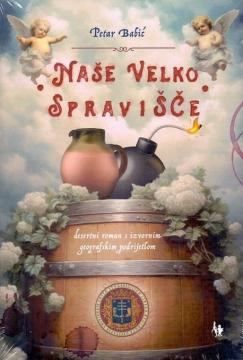
Naše veliko spravišče: desertni roman s izvornim geografskim podrijetlom

Naše veliko spravišče: desertni roman s izvornim geografskim podrijetlom

Petar Babić

Petar Babić's novel Naše velko spravišče was based on a folk theater play, which was based on a legend from the 14th century about the reconciliation of the noble Kalnik peasants Šljivar and the Purgers of Varo.

The core of the play is the famous "Križevački Statutes", and tradition says that the rules were written down just for that occasion during a three-day wine reconciliation, from Friday to Holy Sunday. The act of reconciliation had to be reinforced with two roasted oxen, a gift from the townspeople, and full barrels of local wine, a gift from the noble peasants, and at the same time, a wedding was taking place, constantly on the verge of a mass brawl, of the son of the castellan of Podkalnica, Julček, who was mentally undercapacitated and physically gifted. and daughters of the town judge, tending to the gifted.

With a series of plots, comedic, farcical and grotesque scenes immersed in hectoliters of wine, which helps to clarify the character, unpredictability and tension, all local problems will finally and ironically be solved one drunken night in Krlež, on Vidovdan 1914.

In addition to a fine style that preserves both the authenticity and the archaic layers of the language, Babić equipped the book with several hundred footnotes that are a small encyclopedia of the Križevci region and its prominent people up to the present day, and also added a dictionary of kajkavisisms and graphic attachments and created a unique combination of renovated historical novels and an ethnological collection.

Editor
Kruno Lokotar
Dimensions
24 x 15 cm
Pages
400
Publisher
Jesenski i Turk, Zagreb, 2023.
 
Latin alphabet. Paperback.
Language: Croatian.
ISBN
978-9-53381-007-2

One copy is available

Condition:Unused
 

Are you interested in another book? You can search the offer using our search engine or browse books by category.

You may also be interested in these titles

Robinja

Robinja

Mende Nazer, Damien Lewis

Mende Nazer lives a happy childhood in the Nuba Mountains of Sudan. Surrounded by the love of her family and friends, she dreams of one day being a doctor and caring for people.

Znanje, 2004.
Croatian. Latin alphabet. Paperback.
12.329.24
Hamsin 51

Hamsin 51

Dragan Velikić

The novel Hamsin 51 (1993) is one of Dragan Velikić's early highlights – a spectacular family saga and anti-war work written in the midst of the breakup of Yugoslavia, with an ending that will take place three decades later – in 2022.

PAIDEIA, 2012.
Serbian. Latin alphabet. Paperback.
9.32
The kućica

The kućica

Tihomir Barišić
Quimedia, 2016.
Croatian. Latin alphabet. Paperback.
4.98
Iza spuštenih vjeđa

Iza spuštenih vjeđa

Milan Selaković

This collection of narrative prose features diverse stories and characters, and its title intriguingly suggests mystery and hiddenness.

Znanje, 1981.
Croatian. Latin alphabet. Paperback.
4.98
Neisplakani

Neisplakani

Mirko Božić

The novel "Neisplakani" explores the themes of real life, relationships and conflicts between different social strata, and deeper human emotions and experiences.

Zora, 1955.
Croatian. Latin alphabet. Hardcover.
7.985.99
Usnulo umorstvo: Posljednji slučaj gospođice Marple

Usnulo umorstvo: Posljednji slučaj gospođice Marple

Agatha Christie

Agatha wrote "Sleeping Murder" during World War II as the final Miss Marple novel. Around the same time, she also wrote "Curtain", the last Poirot novel.

Globus, 1978.
Croatian. Latin alphabet. Hardcover with dust jacket.
6.725.39 - 6.746.72