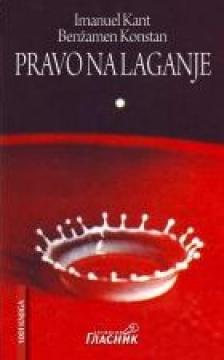

Pravo na laganje

Pravo na laganje

Immanuel Kant, Benjamin Constant

Kant argued that there is no right to lie because telling the truth is an absolute duty, while Constant advocated the possibility of an exception to the duty, arguing that one should lie for the common good, which sparked a famous philosophical debate.

This 1797 discussion begins with Constant's critique of Kant in his essay Des réactions politiques: an absolute duty to tell the truth, if applied unconditionally, would destroy society. Constant gives an example: if a murderer asks about a friend who has hidden in your house, lying would be justified out of philanthropy – because the murderer has no right to the truth.

Kant responds strongly, defending the absolute prohibition of lying. Kant's key arguments:

  • The expression "right to the truth" is meaningless – there is no objective right to the truth, but only a subjective duty of truthfulness (veracitas) towards oneself and others.
  • A lie is a deliberate untruth in a statement to another – it does not depend on harm, but on the violation of a formal duty of reason.
  • The duty to tell the truth is categorical, without exceptions – the basis of all contracts, trusts and rights. If an exception is allowed (e.g. out of love for one's neighbor), the maxim becomes non-universal: the world would collapse into a chaos of distrust.
  • In Constant's example: if you lie to a murderer, you are violating your duty – even if you do not accidentally harm him, lying is a crime against reason. If the murderer forces you to make a statement, the lie is a falsiloquium (untruth), but still a violation – you are responsible for the consequences if the lie enables the crime.

Kant does not allow "white lies" out of humanity – truthfulness is a sacred commandment of reason, of unlimited benefit. Constant sees this as a rigidity that destroys society; Kant sees Constant's approach as opportunism that undermines the foundation of morality.

This debate – one of the most famous in ethics – shows the conflict between absolute deontologism and pragmatic consequentialism.

Naslov izvornika
Des réactions politiques; Über ein vermeintes Recht aus Menschenliebe zu lügen
Prijevod
Nebojša Zdravković
Urednik
Nebojša Zdravković
Naslovnica
Miloš Majstorović
Dimenzije
17,5 x 10,5 cm
Broj strana
97
Nakladnik
Službeni glasnik, Beograd, 2008.
 
Latinica. Broširano.
Jezik: Srpski.

Jedan primjerak je u ponudi

Stanje:Korišteno, u odličnom stanju
Dodano u košaricu!
 

Zanima Vas i neka druga knjiga? Možete pretražiti našu ponudu pomoću tražilice ili prelistati knjige po kategorijama.

Možda će Vas zanimati i ovi naslovi

Koji su stvarni napreci koje je metafizika ostvarila u Nemačkoj od Lajbnicovih i Volfovih vremena

Koji su stvarni napreci koje je metafizika ostvarila u Nemačkoj od Lajbnicovih i Volfovih vremena

Immanuel Kant
Svetovi, 2004.
Srpski. Ćirilica. Broširano.
9,998,99
Religija unutar granica čistog uma

Religija unutar granica čistog uma

Immanuel Kant

Religija unutar granica čistog uma je knjiga njemačkog filozofa Immanuela Kanta iz 1793. godine. Iako su njezina svrha i izvorna namjera postali predmet osporavanja, golem i trajan utjecaj knjige na povijest teologije i filozofije religije je neosporan.

BIGZ, 1990.
Srpski. Latinica. Tvrde korice s ovitkom.
16,24
Kritika rasudne snage

Kritika rasudne snage

Immanuel Kant

Uz Kritiku čistoga uma i Kritiku praktičnog uma ovo treće Kantovo glavno djelo spada u ugaone kamene njegove filozofske zgrade, ali i zaokružuje čitav njegov pogled na svijet.

Kultura, 1957.
Hrvatski. Latinica. Tvrde korice s ovitkom.
23,46
Leto

Leto

Albert Camus

Zbirka književnih i filozofskih eseja Alberta Camusa.

Nolit, 1956.
Srpski. Ćirilica. Broširano s ovitkom.
6,32
Stiegler and Technics

Stiegler and Technics

Christina Howells, Gerald Moore, Christopher Johnson, Michael Lewis, Ian James, Serge Trottein, P...

Ova zbirka eseja prva je knjiga na engleskom jeziku o djelu Bernarda Stieglera, sve značajnije ličnosti u novoj generaciji francuskih filozofa koja se, tijekom posljednjih desetak godina, pojavila nakon Foucaulta, Deleuzea i Derridaa.

Edinburgh University Press, 2013.
Engleski. Latinica. Broširano.
13,2410,59
Poezija iz budućnosti

Poezija iz budućnosti

Srećko Horvat

Autor, u svom pozivu na novi radikalni internacionalizam, ukazuje na nužnost nadilaženja trenutno prevladavajućih okvira: granica, nacionalnih identiteta i maksimalizacije profita kao mjere svih stvari.

V.B.Z, 2023.
Hrvatski. Latinica. Broširano.
13,28