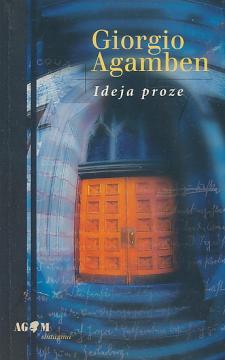
Ideja proze

Ideja proze

Giorgio Agamben

With the works of G. Agamben, tradition is acknowledged to have a role in the transmission of a linguistic or cultural phenomenon from the past to the present, but the transmission is no longer in the service of the return of the same but, paradoxically,

A tradition (tradizione) that requires transmission in the form of translation (traduzione) – because it comes from the past and does not speak the language of the present – ​​cannot but have the effect of betrayal (tmdimento). This revelation of the truth through its betrayal was quite clear to T. S. Eliot's contemporary W. Benjamin: In order for a part of the past to be touched by the present moment, there must be no continuity between them. In other words, if tradition were able to make the whole present, to bring to the surface the entire submerged cultural good, the boundary between the past and the present would disappear without a trace, and with it history. Bearing in mind where exactly such an attempt to deal with the problem of human communication and history would lead, Agamben takes on the task of articulating, in parallel with his most original philosophical project – to think the existence of language as the existence of potency (D. Heller-Roazen) – the continuation of Benjamin by other means.

Original title
Idea della prosa
Translation
Ivan Molek
Editor
Kruno Lokotar
Graphics design
Melina Mikulić
Dimensions
18.5 x 12 cm
Pages
137
Publisher
AGM, Zagreb, 2004.
 
Latin alphabet. Paperback.
Language: Croatian.

One copy is available

Condition:Unused
 

Are you interested in another book? You can search the offer using our search engine or browse books by category.

You may also be interested in these titles

Metodika književnog odgoja i obrazovanja

Metodika književnog odgoja i obrazovanja

Dragutin Rosandić

A fundamental work of Croatian methodological science that explores the theory, goals, and methods of teaching literature, connecting the pedagogical, psychological, and aesthetic aspects of literary education.

Školska knjiga, 1988.
Croatian. Latin alphabet. Hardcover.
16.42
Skrivena teorija

Skrivena teorija

Pavao Pavličić

Pavle Pavličić's hidden theory was included among the ten best domestic nonfiction books in 2006 in the "Jutarnje lista" selection.

Matica hrvatska, 2006.
Croatian. Latin alphabet. Hardcover with dust jacket.
11.98
Kazališne veze Osijeka i Pečuha / Eszék és Pécs színházi kapcsolata

Kazališne veze Osijeka i Pečuha / Eszék és Pécs színházi kapcsolata

Zvonimir Ivković

The book provides a thorough chronicle and analysis of centuries-old theatrical contacts between two cities – Osijek and Pécs – which historically shared the cultural space of the Pannonian Plain, especially during the period of the Habsburg Monarchy.

Matica hrvatska, 2012.
Croatian. Latin alphabet. Hardcover.
13.64
Haosmos Basara

Haosmos Basara

Novica Milić

Novica Milić gives Basara the status he deserves - he reads him as a relevant world writer. He "pulls" it out of the bilge of the palanquin and places it on the stage of world literature, where only one thing matters: what and how the writer does with wor

Factum izdavaštvo, 2020.
Serbian. Cyrillic alphabet. Paperback.
9.56
Tin Ujević u jugoslovenskoj književnoj kritici

Tin Ujević u jugoslovenskoj književnoj kritici

Dragomir Gajević

This extensive 438-page work analyzes the reception and critical reviews of the work of one of the most significant Croatian poets, Tin Ujević, within the Yugoslav literary space.

Grafički zavod Hrvatske (GZH), 1988.
Croatian. Latin alphabet. Hardcover.
7.265.45
O literaturi

O literaturi

Maksim Gorki

The first third of the book provides reviews of Russian literature (Chekhov, Ljeskov, Pushkin...). The second chapter deals with world literature (Balzac, Stendhal, Roland...), and the third chapter contains general articles.

Kultura, 1949.
Serbian. Latin alphabet. Hardcover.
5.12