O slobodi

The founder of modern liberalism, John Stuart Mill, in his essay "On Liberty" defends individual freedom from social and state pressure, setting limits on power over the individual and advocating freedom of thought, speech, and action.
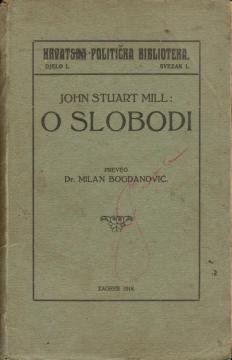
On Freedom (1859) is one of the most influential works of liberal political philosophy of the 19th century. The Croatian translation by Milan Bogdanović was published in 1918 in Zagreb. The translation appeared in the final phase of the First World War and on the eve of the collapse of Austria-Hungary, when ideas about freedom and self-determination were particularly relevant among the South Slavic peoples.
In this classic essay, Mill poses a fundamental question: to what extent may society or the state restrict the freedom of the individual? He distinguishes freedom of thought and expression from freedom of action. The main principle he defends is the harm principle: the only justifiable basis for restricting individual freedom is to prevent harm to others. As long as an individual does not harm others, society has no right to interfere in his life, thoughts, or behavior.
In the Croatian context of 1918, the translation was part of a broader reception of Western liberal thought and served as intellectual support for the ideas of freedom and democracy in the newly formed state. The style is clear, argumentative, and eloquent, typical of Mill's philosophy of utilitarianism enriched by humanism. On Liberty remains a foundational work of liberalism, influencing debates about human rights, freedom of speech, and the limits of state power even today.
One copy is available