Gospodin G.A. u gradu X
Rare book

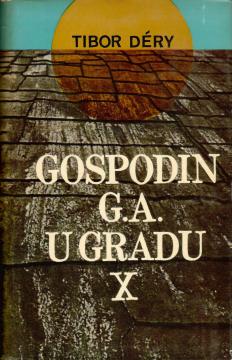
Gospodin G.A. u gradu X

Tibor Dery

Mr. G.A. in the City of X by Tibor Déry is a Kafkaesque dystopia about a man who arrives in a perfect city where everything is permitted, but precisely because of that, nothing has meaning or value anymore.

Mr. G.A. in the City of X (1964) is one of the most significant works of the Hungarian writer Tibor Déry (1894–1977). The novel was written in prison, where the author was imprisoned for participating in the Hungarian Revolution of 1956, and is considered the pinnacle of his late oeuvre and an excellent satire on totalitarian societies.

The main character, Mr. G.A., arrives in the mysterious city of X – a seemingly ideally arranged place where complete freedom reigns. Residents can do whatever they want, there are no prohibitions, no scarcity, no coercion. But it is precisely this absolute freedom that leads to absurdity: without restrictions, meaning, motivation and the true joy of life also disappear. The city becomes a place of spiritual emptiness, boredom and dehumanization. Déry masterfully shows how utopia in practice becomes dystopia.

The novel is strongly Kafkaesque: an atmosphere of misunderstanding, bureaucratic absurdity and a sense of being trapped within a seemingly free system permeate the entire work. Déry uses irony, grotesque and philosophical depth to criticize not only the socialist system of his time, but also more broadly – ​​any ideology that promises perfection. Many have seen the novel as a mirror of real socialism, but the work has universal value and is read today as a criticism of contemporary consumerism and “freedom” in which everything is permitted and nothing else matters.

The style is elegant, precise and introspective. Déry does not offer simple answers, but asks deep questions about the nature of freedom, happiness, the meaning of existence and the limits of human community. The novel is extremely dense – every sentence carries a multi-layered meaning.

Mr. G.A. in the city of X is a masterpiece of 20th-century Hungarian literature and an outstanding example of intellectual prose that combines literary value with sharp social criticism.

Original title
G. A. úr X.-ben
Translation
Jadranka Damjanov
Editor
Kalman Mesarić
Graphics design
Boris Dogan
Dimensions
20.5 x 13 cm
Pages
486
Publisher
Naprijed, Zagreb, 1967.
 
Latin alphabet. Hardcover with dust jacket.
Language: Croatian.

One copy is available

Condition:Unused
 

Are you interested in another book? You can search the offer using our search engine or browse books by category.

You may also be interested in these titles

Duga topla jesen

Duga topla jesen

Tibor Dery

Tibor Déry's Long Warm Autumn is an intimate novel about old age, dealing with the inexorable decay of body and spirit, and the last attempts to escape from inevitable death.

Nolit, 1989.
Serbian. Latin alphabet. Hardcover with dust jacket.
9.90
Krvava arena

Krvava arena

Vicente Blasco Ibanez

The Bloody Arena (1908) is a naturalistic novel about the rise and fall of bullfighter Juan Gallardo. A poor young man becomes a famous matador, but is destroyed by love, vice, fear, and tragedies in the arena – a critique of Spanish bullfighting and soci

Naprijed, 1984.
Croatian. Latin alphabet. Hardcover with dust jacket.
4.76
Fabian: Pripovijest o moralistu

Fabian: Pripovijest o moralistu

Erich Kästner

Jakob Fabian, an unemployed Germanist and moralist, wanders through Berlin in the 1930s, observing the moral, political and social decay and the rise of Nazism. He falls in love with Cornelia, but tragedies and nonsense lead him to a tragic end. Criticism

Mladost, 1952.
Croatian. Latin alphabet. Paperback.
5.32
Blato

Blato

Milana Vlaović

Miana Vlaović's debut novel is a story about three generations of women in a patriarchal province, filled with recurring patterns of fate - love, betrayal, poverty, violence, and small struggles for dignity.

V.B.Z, 2007.
Croatian. Latin alphabet. Paperback.
6.38
Devojka i golubovi

Devojka i golubovi

Jaroslaw Iwaszkiewicz

Young Edek lives with his elderly father who tries to keep his son by his side. The boy's longing for freedom and a girl clashes with his father's possessiveness. The pigeons symbolize unattainable freedom. The conflict leads to a tragic ending.

Svjetlost, 1965.
Serbian. Latin alphabet. Paperback.
2.14
Hronika o siromašnim ljubavnicima

Hronika o siromašnim ljubavnicima

Vasco Pratolini

In Florence 1925–1926, in the poor Via del Corno, the residents live in love, poverty and fear. The arrival of fascism destroys the community: lovers fight, some die from violence, but popular solidarity survives.

Svjetlost, 1966.
Serbian. Latin alphabet. Paperback.
The book consists of two volumes
4.56