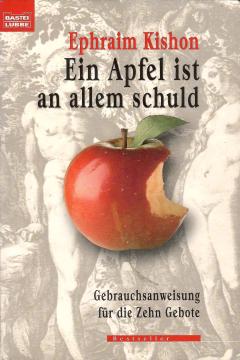
Ein Apfel ist an allem schuld

Ein Apfel ist an allem schuld

Ephraim Kishon

Kishon satirizes the Ten Commandments in a series of short stories. Human weaknesses, hypocrisy and futile attempts to live a consistent life according to the law are the source of comedy. The title alludes to the apple of Eden.

Ein Apfel ist an allem schuld is a humorous retelling of the Ten Commandments, translated from Hebrew into German by the author himself, along with Ursula Abrahamy and Friedrich Torberg. Kishon calls the Bible “a unique, wonderful work that transcends human comprehension,” but approaches it with the same merciless but warm satirical gift he has for all human institutions. Each commandment is given its own cycle of stories: the first on the devaluing of idols and telephone gods, the third on a chaotic holiday and a “fishnet stocking carnival,” the fifth on a series of misunderstood murders, the seventh on petty daily theft as a common folk sport, the eighth on professional false witness, the ninth on neighborly envy and squaring the circle.

The title alludes to the apple of Eden—the fruit that, according to the biblical story, causes man to fall into sin; but Kishon twists this motif: the fault lies not in the apple or in the Creator, but in the eternal human clumsiness to interpret even the clearest commandment in a way that suits it. A special charm is given by the final vignette in which the "apple worm" himself makes a defense speech against Kishon's accusation — how no one has ever so decisively shifted the blame to the apple. The pinnacle of Kishon's satirical biblical journalism, extremely popular in the German-speaking world.

Translation
Ephraim Kishon, Ursula Abrahamy, Friedrich Torberg
Dimensions
18.5 x 12.5 cm
Pages
397
Publisher
Bastei Lübbe, Köln, 1998.
 
Latin alphabet. Paperback.
Language: German.

One copy is available

Condition:Unused
 

Are you interested in another book? You can search the offer using our search engine or browse books by category.

You may also be interested in these titles

Nema slonova u Meksiku

Nema slonova u Meksiku

Zoran Pilić

These stories will make us laugh, but also imperceptibly take us to the other, dark side...

Fraktura, 2014.
Croatian. Latin alphabet. Hardcover with dust jacket.
6.985.58
Gargantua

Gargantua

François Rabelais

The birth, childhood, upbringing and warlike exploits of the giant Gargantua: a satire on scholasticism, wars, monasticism and society, with grotesque humour, enormous eating/drinking and utopian ideals.

Matica hrvatska, 1996.
Croatian. Latin alphabet. Paperback.
8.32
Mačak pod šljemom

Mačak pod šljemom

Joža Horvat

Cult (anti)war novel by Jože Horvat from 1959, a famous Croatian writer for children and adults, playwright, screenwriter, publicist and world sailor.

Grafički zavod Hrvatske (GZH), 1968.
Croatian. Latin alphabet. Hardcover with dust jacket.
7.26
Kako podići krov

Kako podići krov

Jane Wenham-Jones

Jane Wenham-Jones, the British master of humor and irony, in the novel How to Raise a Roof leads us through the hilarious and painful adventures of Cari, a woman on the verge of financial and emotional ruin.

Marjan tisak, 2006.
Croatian. Latin alphabet. Paperback.
4.36
Pomalo neobični slučajevi

Pomalo neobični slučajevi

Daniil Ivanovič Harms

The second edition of stories, sketches, anecdotes and shorter pieces by a distinctive Russian writer who has gained numerous fans among the Croatian reading public, primarily because of the laughter that balances on a thin line - the dividing line betwee

Šareni dućan, 2001.
Croatian. Latin alphabet. Paperback.
10.26
Zlatno tele

Zlatno tele

Ilja Iljf, Jevgenij Petrov

The Golden Calf (1931) is a brilliant satirical picaresque adventure, a sequel to the legendary 12 Chairs, where the great schemer Ostap Bender returns in full glory – charming, cynical, irredeemably cunning and always one step ahead of everyone else.

Kultura, 1946.
Croatian. Latin alphabet. Hardcover with dust jacket.
7.56