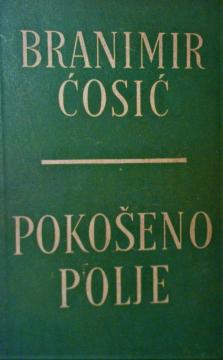
Pokošeno polje

Pokošeno polje

Branimir Ćosić

Mowed Field is the most significant and last novel by the Serbian writer Branimir Ćosić (1903–1934), completed in 1933, just five months before his death from tuberculosis at the age of 31.

The novel is divided into two parts: the first is an autobiographical account of the war-torn childhood and family of the protagonist (Ćosić's own fate from World War I), the second depicts the moral and social collapse of post-war Yugoslavia, corruption, existential crisis and the meaninglessness of life. A tragic, introspective portrait of a generation broken by war and times of crisis.

Branimir Ćosić, born in the village of Štitar near Šabac, studied philosophy and law in Belgrade, worked as a journalist and literary critic (Politika, Vreme), belongs to the generation of Serbian writers between the two wars – realist-expressionist, with elements of social criticism and existential melancholy. He died young of tuberculosis, leaving behind a limited oeuvre: the novels Vrzino kolo (1927), Mrtvi se vraćaju (1930), collections of stories and essays, but Pokosena polja is considered his peak and most mature work.

The novel was first published in 1933 by Geca Kon. It consists of two parts:

  • The first part - autobiographical, lyrical and intimate: shows the childhood and youth of the main character (clearly the writer's alter ego) in the whirlwind of the First World War - hunger, misery, loss of family, village destroyed, moral shock. This is the "mown field" of life – a metaphor for a ruined youth and generation.
  • The second part – a broader social novel: the hero in post-war Belgrade faces corruption, bureaucracy, false intelligence, existential emptiness, the impossibility of love and meaning. The characters are typical of interwar literature: failed intellectuals, cynics, opportunists. The style is psychologically deep, with introspection, fragmentary storytelling and sharp social observations.

The work is a critique of post-war Yugoslavia - decadence, loss of ideals, meaninglessness - similar to the motifs of Crnjanski (Migration), Andrić or Kočić, but with a stronger autobiographical and intimate tone. The title symbolizes a destroyed generation, "mown down" by war and time.

Editor
Marijan Matković
Dimensions
20 x 14 cm
Pages
498
Publisher
Nakladni zavod Hrvatske, Zagreb, 1949.
 
Latin alphabet. Hardcover.
Language: Serbian.

One copy is available

Condition:Used, very good condition
Damages or inconvenience notice:
  • Traces of patina
 

Are you interested in another book? You can search the offer using our search engine or browse books by category.

You may also be interested in these titles

Pokošeno polje

Pokošeno polje

Branimir Ćosić

Mown Fields (1933) represents the culmination and swan song of a life that ended too soon – the author finished the novel just five months before his death from tuberculosis, at the age of thirty-one.

Svjetlost, 1961.
Serbian. Latin alphabet. Hardcover.
The book consists of two volumes
5.34
Doba života, doba smrti / Slavoluk pobjede / Ljubi bližnjega svoga

Doba života, doba smrti / Slavoluk pobjede / Ljubi bližnjega svoga

Erich Maria Remarque

Selected works of Remarque in three volumes.

SKD Prosvjeta, 1963.
Croatian. Latin alphabet. Hardcover.
The book consists of 3 volumes
9.56
Odsustvo do buđenja

Odsustvo do buđenja

Leon Uris

Battle Cry (1953) is Leon Uris's debut novel based on his experience in World War II as a member of the 6th Marine Regiment.

Otokar Keršovani, 1970.
Croatian. Latin alphabet. Hardcover with dust jacket.
8.24
Sanjaj nemogući san

Sanjaj nemogući san

Johannes Mario Simmel

From the bestselling author of "Jimmy and the Rainbow," comes a novel that weaves a love story with the stirring events of the Bosnian war. This story, woven into the historical context, reminds us that sometimes the impossible dream is the only one worth

Mozaik knjiga, 1997.
Croatian. Latin alphabet. Hardcover.
7.42
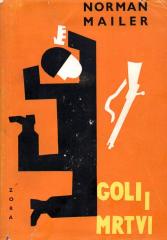
Goli i mrtvi

Goli i mrtvi

Norman Mailer

Norman Mailer's novel The Naked and the Dead (1948) is a masterpiece of American literature about World War II. The plot follows a platoon of American soldiers on the fictional Pacific island of Anopopeia during their fight against the Japanese army.

Zora, 1964.
Croatian. Latin alphabet. Hardcover with dust jacket.
7.42 - 7.46
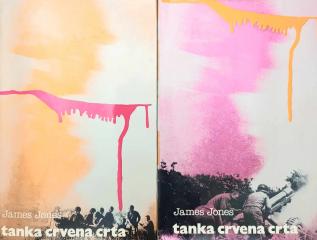
Tanka crvena crta 1-2

Tanka crvena crta 1-2

James Jones

The Thin Red Line (1962) is a realistic depiction of war through the experiences of soldiers in the Battle of Guadalcanal during World War II. The novel follows Company C of the U.S. Marines in the Pacific in 1942, focusing on their internal struggles und

Globus, 1980.
Croatian. Latin alphabet. Hardcover with dust jacket.
The book consists of two volumes
13.56