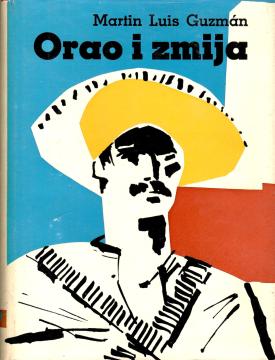
Orao i zmija

Orao i zmija

Martín Luis Guzmán

The Eagle and the Serpent depicts the author's experiences during the Mexican Revolution. Through encounters with revolutionary leaders and the events of the war, the narrator discovers the ideals, conflicts, and disappointments of the revolution.

The Eagle and the Serpent by Martin Luis Guzmán is an autobiographical novel based on the author's experiences during the Mexican Revolution from 1913 to 1915. The narrator, a young intellectual and journalist, abandons civic life and joins the revolutionary movement, believing that it will bring freedom and a more just society. The novel is divided into two parts – Revolutionary Hopes and In the Hour of Victory – which follow his journey from initial idealism to disillusionment with political struggles.

During his journey through Mexico, the narrator meets the most important leaders of the revolution: Venustiano Carranza, Pancho Villa, Álvaro Obregón, Felipe Ángeles and others. He does not portray them as infallible heroes, but as complex people whose decisions are shaped by personal ambition, courage, cruelty and desire for power. The chapters dedicated to Pancho Villa are particularly noteworthy, in which the author describes his charisma, military talent, but also his unpredictable nature and tendency to violence.

The novel is not a classic chronological narrative, but a series of connected episodes, portraits, and memories that together create a picture of the revolution from the perspective of its participants. Guzmán depicts military campaigns, political negotiations, the revolutionaries' entry into Mexico City, the breakdown of alliances, and conflicts between former allies.

The novel's ending is marked by the narrator's disappointment as he realizes that the original ideals of the revolution have been suppressed by the struggle for power. The work is at once a historical document, a psychological analysis of the revolutionary leaders, and a critique of the political violence that often replaces the ideals that started the revolution.

Original title
El águila y la serpiente
Translation
Sonia i Catalina Fertilio
Dimensions
20 x 14.5 cm
Pages
432
Publisher
Naprijed, Zagreb, 1965.
 
Latin alphabet. Hardcover with dust jacket.
Language: Croatian.

Two copies are available

Copy number 1

Condition:Unused

Copy number 2

Condition:Used, very good condition
Damages or inconvenience notice:
  • Yellowed pages
  • A message of a personal nature
 

Are you interested in another book? You can search the offer using our search engine or browse books by category.

You may also be interested in these titles

Sjaj Danice ilirske, ili preko 630 citata o raznim krijepostima i dužnostima

Sjaj Danice ilirske, ili preko 630 citata o raznim krijepostima i dužnostima

An anthology from the 20th anniversary of Danica Illyrska with more than 630 poems and quotes about virtues and duties. The Illyrian spirit transformed into a practical moral and patriotic compass for the education of the heart, mind, and community.

Nakladom antikvarne knjižare M. F. Strmeckoga, 1888.
Croatian. Latin alphabet. Paperback.
8.46
Klima izdaje

Klima izdaje

Andrew Boyle

A detailed study of the infamous Cambridge spies, a group of British intellectuals who spied for the Soviet Union during the 20th century. The book is written in a documentary style, but with a tense narrative, making it a compelling read about betrayal a

August Cesarec, 1982.
Croatian. Latin alphabet. Hardcover with dust jacket.
6.244.68
Dinamit: Povijest klasnog nasilja u Americi

Dinamit: Povijest klasnog nasilja u Americi

Louis Adamić

The book documents a century of violence in the American labor movement — from 19th-century mining strikes to bombings and clashes with police — and exposes the brutal background to America's "class war."

Naklada Binoza, 1933.
Croatian. Latin alphabet. Hardcover with dust jacket.
7.24
Pisma Cosimu I. Mediciju 1566.

Pisma Cosimu I. Mediciju 1566.

Marin Držić

Držić's letters to Cosimo I de' Medici represent a significant document of Croatian Renaissance literature and history. Držić sent three letters to Cosimo I, Grand Duke of Tuscany, between June and August 1566, while he was staying in Florence.

Croatian P.E.N. Centre & Most / The Bridge, 1993.
Croatian. Latin alphabet. Paperback.
8.32
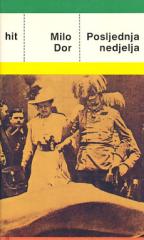
Posljednja nedjelja

Posljednja nedjelja

Milo Dor

The Last Sunday of Mila Dora is a historical novel about the Sarajevo assassination of 1914. Through the investigation of Judge Leo Pfeffer, it depicts the events that led to the assassination and the outbreak of World War I.

Znanje, 1985.
Croatian. Latin alphabet. Hardcover with dust jacket.
4.22
Vijetnam

Vijetnam

Marry Mccarthy

Vietnam features Mary McCarthy's travelogues of war-torn Vietnam. The author critically portrays the war, political propaganda, and the dire consequences of the conflict for the civilian population.

Znanje, 1969.
Croatian. Latin alphabet. Hardcover with dust jacket.
8.46