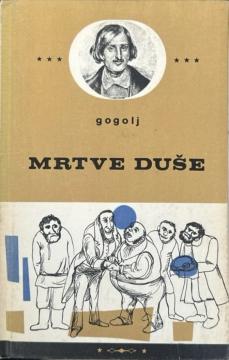
Mrtve duše

Mrtve duše

Nikolaj Vasiljevič Gogolj

This immortal, timeless, always current story about the "auditor" of dead souls, Čičikov, will remain, an age-old grotesque monument to the apparently age-old human greed, stupidity, rapacity, sinfulness...

Gogol's finely honed critical spirit seems to see just about all the weaknesses of his contemporaries, precisely dissecting them and serving them with mild mockery and irony, but also with benevolence towards everything human, with benevolent understanding for everyone, without accusing anyone. With astonishing ease, he exposed the circumstances of the time and mocked the provincial mentality, landowners and nobles, officials and skorojevićs, creating characters who became models for laziness, obstinacy, self-love, bribery, hypocrisy in Russian society... At one point even - when living, but spiritually the dead, whose only goal is to gain a living by any means and at any cost, haggle over the dead (souls) talking about them as if they were alive - blurring the line between the living and the dead. So Gogol in the book, but also with the book itself, shook the laws of space and time, because if we take a look at his house or ours or, for that matter, whose house, it seems that the circumstances and people are more or less the same as they were a century or two ago , and we can calmly put our hand in the fire if it wasn't much different before...

Translation
Iso Velikanović
Editor
Vlatko Pavletić
Graphics design
Aleksandar Srnec
Dimensions
20 x 14 cm
Pages
385
Publisher
Matica hrvatska, Zagreb, 1965.
 
Latin alphabet. Hardcover.
Language: Croatian.

No copies available

The last copy was sold recently.
 

Are you interested in another book? You can search the offer using our search engine or browse books by category.

You may also be interested in these titles

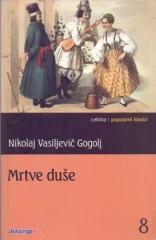
Mrtve duše

Mrtve duše

Nikolaj Vasiljevič Gogolj

Dead Souls (1842) is a brilliant satire that exposes the moral and social rot of imperial Russia through Chichikov's fraud with dead serfs, with Gogol's virtuoso mix of humor, irony and lyricism.

Jutarnji list, 2004.
Croatian. Latin alphabet. Paperback.
4.99
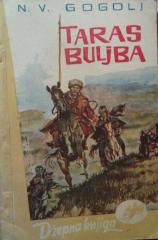
Taras Buljba

Taras Buljba

Nikolaj Vasiljevič Gogolj
Veselin Masleša, 1985.
Croatian. Latin alphabet. Hardcover.
2.99 - 3.12
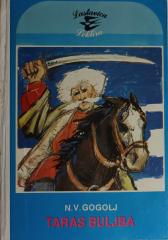
Taras Buljba

Taras Buljba

Nikolaj Vasiljevič Gogolj
Svjetlost, 1961.
Croatian. Latin alphabet. Paperback.
2.78 - 3.98
Usta puna zemlje

Usta puna zemlje

Branimir Šćepanović

The novel "Usta puna zemlje" (1970), the masterpiece of the Serbian writer Branimir Šćepanović, is a psychologically in-depth explorer of the limits of the human soul, solitude and existential freedom, reminiscent of Kafka and Camus.

BIGZ, 1987.
Serbian. Latin alphabet. Paperback.
3.96 - 3.98
Stotina godina (antikronika)

Stotina godina (antikronika)

Dario Harjaček

The novel One Hundred Years by Dario Harjaček provides a panoramic view of Trešnjevka and its inhabitants through a century of changes, ideologies, and human destinies – a mosaic of Zagreb in which life, art, and history intertwine.

Oceanmore, 2025.
Croatian. Latin alphabet. Paperback.
13.42
Proces

Proces

Franz Kafka

Kafka wrote The Process between 1914 and 1915, published posthumously in 1925. The novel is unfinished but with an added final chapter by Max Brod. Edition with a foreword by B. Živojinović and an afterword by Walter Killi.

BIGZ, 1990.
Serbian. Latin alphabet. Paperback.
4.26