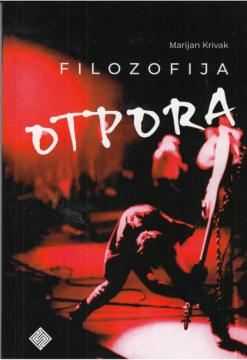
Filozofija otpora

Filozofija otpora

Marijan Krivak

In a world of entropic orders networked by "control societies" (Deleuze), the only thing left for us is a peculiar PHILOSOPHY OF RESISTANCE.

Resistance is like a "human too human" urge to conquer the enclave of Justice in the impotent (only) formal framework of human rights and freedoms. Furthermore, philosophy today must be in what has been called eudaimonia since Antiquity - happiness as bliss. The answer, on the other hand, to the question of what philosophy is, can only be a "philosophizing answer". Her saying "love for wisdom" is no longer sufficient for us as decisive. Heidegger and Deleuze&Guattari get the solution to their question about the "value" of philosophy - according to my deep conviction - in Badiou's peculiar "metaphysics of real happiness". The central part of the book - its interlude - deals with the phenomena of language and art, especially film. Julij Knifer's artwork (juxtaposed with Mihovil Pansini's film opus) becomes an act of freedom, therefore RESISTANCE! Both authors strive, with their anti-stance - Knifer with anti-painting, and Pansini with anti-film - to affirm the art of sàmu. How, then, to mark the place of LANGUAGE in such a "philosophy of resistance"? Language, as something that belongs most to every human entity, should be freed from its communicative purpose. We could get there if we restore LANGUAGE as the generic essence of man. Finally, reaching the language is also the medium of coming into the world (Sloterdijk). The last part of the book is dedicated to the term "fascisization". What is fascism? The term to which I return again and again needs to be explained in the operational sense of its current philosophical-theoretical usability. Is it still possible to approach the term historically and epistemologically? What is PHILOSOPHICAL RESISTANCE RESISTANCE to a senseless and conceptless world? Through this art, the revolutionary desire for an event of inhabiting a new land and people in which philosophy is born is revealed. Philosophy is re-territorialized against all the dispositifs of capital, in a "non-fascist existence, in the field of immanence."

Dimensions
24 x 17 cm
Pages
171
Publisher
Filozofski fakultet, Osijek, 2019.
 
Distribution: 120 copies
 
Latin alphabet. Paperback.
Language: Croatian.

One copy is available

Condition:Used, excellent condition
 

Are you interested in another book? You can search the offer using our search engine or browse books by category.

You may also be interested in these titles

Što su Česi?: kratki pregled činjenica i pokušaj objašnjenja

Što su Česi?: kratki pregled činjenica i pokušaj objašnjenja

Jan Patočka

In the book before you, Jan Patočka wrote a paradigmatic essay on the Central European identity of a Slavic people.

Durieux, 2000.
Croatian. Latin alphabet. Paperback.
7.74
O duhu otvorenosti: dimenzije misaonog nasleđa Radomira Konstantinovića

O duhu otvorenosti: dimenzije misaonog nasleđa Radomira Konstantinovića

The collection is an important contribution to the revitalization of Konstantinović's thought in the post-Yugoslav space, demonstrating that his critique of the rural mind remains relevant for understanding contemporary social and political pathologies.

Gradska biblioteka Subotica, 2016.
Serbian. Latin alphabet. Paperback.
7.32
Ljudska povijest emocija: Kako su naši osjećaji sagradili svijet kakav poznajemo

Ljudska povijest emocija: Kako su naši osjećaji sagradili svijet kakav poznajemo

Richard Firth-Godbehere

In this provocative and interdisciplinary book, the author shows that emotions are not universal biological constants, but change across time, cultures, and social contexts – and they are precisely those that are crucial in shaping the history of humanity

Školska knjiga, 2023.
Croatian. Latin alphabet. Hardcover with dust jacket.
21.36
Kopernikanska mobilizacija i ptolomejsko razoružanje: Ogled iz estetike

Kopernikanska mobilizacija i ptolomejsko razoružanje: Ogled iz estetike

Peter Sloterdijk

In this provocative essay, Sloterdijk intervenes in the heated debate of the 1980s about modernism and postmodernism. A short, sharp text – essential for understanding Sloterdijk's early approach to aesthetics, media and the crisis of modernity.

Svetovi, 1988.
Serbian. Latin alphabet. Paperback with dust jacket.
8.36
Perpetuum mobile

Perpetuum mobile

Mihajlo Velimirović

The book "Perpetuum mobile" by Mihajlo Velimirović, published in 1960, belongs to the genre of philosophical-literary essays and reflections, with elements of science fiction and technical speculation.

Epoha, 1960.
Croatian. Latin alphabet. Hardcover with dust jacket.
3.96 - 3.98