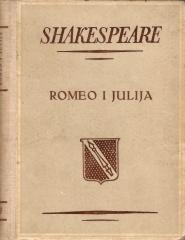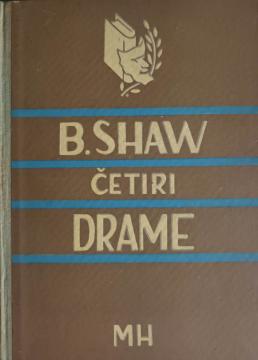
Bernard Shaw, an Irish playwright and critic, is known for his sharp social commentary and witty language. His plays often explore themes of class, morality, love and human nature.
Translation
Teodor Peičić, Vlado Habunek
Graphics design
Valerija Pavić
Dimensions
20 x 15 cm
Pages
356
Publisher
Matica hrvatska, Zagreb, 1951.
Distribution: 6,000 copies
Latin alphabet. Hardcover.
Language: Croatian.
One copy is available
Condition:Used, good condition (visible signs of use)
A Doll's House (1879) by Norwegian playwright Henrik Ibsen is considered a masterpiece of realism and feminist literature. Set in 19th-century Norway, it follows Nora Helmer, the wife of banker Torvald.
Mozaik knjiga, 2004.
Croatian. Latin alphabet. Hardcover.
11.32 €
Plays • Croatian literature • First editions
The drama depicts an idealized youthful marriage between an aircraft designer and a young woman and its rapid dissolution after the wedding. One of Begović's most important dramatic works, recognizable for its irony, psychological depth, and criticism of
Hrvatski štamparski zavod d.d., 1922.
Croatian. Latin alphabet. Paperback.
17.36 - 24.62 €
Plays • Croatian literature • Social literature
A three-act drama by Jakša Kušan based on the motifs of the famous Bosnian sevdalinka of the same title, it is one of Kušan's early dramatic works inspired by the Muslim environment of Bosnia.
Tiskara braća Jakšić, 1942.
Croatian. Latin alphabet. Paperback.
9.74 €
Plays • Croatian literature • Poetry
The book contains a selection of Šop's poetry and prose, the play The Eternal Prelude, Šop's letters to Dragutin Tadijanović, and memories of his acquaintance with Francis Jammes. The selection was compiled and the foreword written by Branimir Donat.
Mozaik knjiga, 1997.
Croatian. Latin alphabet. Hardcover with dust jacket.
Pastoral drama (comedy) in five acts, written in double-rhymed twelve-line stanzas (with eight-line stanzas in the lyrical parts), the oldest preserved play by Držić (premiered in 1548 in Dubrovnik, printed in 1551 in Venice).
This is a collection that begins with a part of the genocide in Srebrenica, and ends with a monologue of war criminals, in which Bašović opens and closes the cycle of the war curse.