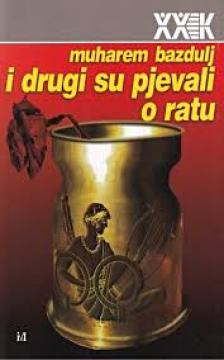
I drugi su pjevali o ratu: Odjeci raspada Jugoslavije u engleskoj i američkoj književnosti
In this book of essays, Muharem Bazdulj analyzes how the collapse of Yugoslavia and the wars of the 1990s resonated in Anglo-Saxon literature – from pre-war stereotypes to war and post-war depictions.
The title alludes to "others" (foreigners) singing about our war, often through the filter of media, prejudice and political agendas.
The book is structured in six chapters:
- First chapter: Sketch of the presence of the Balkans in English literature from the 19th century to the 1990s - starting from Vesna Goldsworthy ("Inventing Ruritania"), Marija Todorova ("Imagining the Balkans"), Božidar Jezernik and Omer Hadžiselimović. Bazdulj shows how the Balkans have long been an exotic, chaotic "other" in British perception (Byron, Durham, Rebecca West...).
- Second chapter: Literary works created during the war - Susan Sontag (essays and the play "Waiting for Godot" in Sarajevo), Joseph Brodsky, Salman Rushdie and Mark Ravenhill - a critical review of their attitudes and engagements.
- Chapter Three: Crime and Spy Novels – Colin Falconer and Frederick Forsyth – where the Balkans appear as an exotic stage for action, intrigue and stereotypes.
- Chapters Four and Five: Post-War Accounts – Lawrence Weschler, Geraldine Brooks ("People of the Book"), Steven Galloway ("The Cellist of Sarajevo") – how the war is remembered and romanticized in fiction.
- Chapter Six: Conclusion – media interest in the Balkans has been topical and superficial, academically specialized and narrow. Bazdulj emphasizes the difference between sensationalism and in-depth analysis, and how Anglo-Saxon literature often perpetuates Balkan myths.
This book is not just a review, but a critical intervention: Bazdulj shows how the war is not just "ours", but a global narrative that shapes images of us. Provocative, erudite and lucid – ideal for understanding cultural stereotypes and the reception of the Yugoslav wars in the West.
Editor
Ivan Čolović
Graphics design
Ivan Mesner
Dimensions
17 x 12 cm
Pages
184
Publisher
Biblioteka XX vek, Beograd, 2013.
Latin alphabet. Paperback.
Language: Croatian.
One copy is available
Condition:Unused
Added to cart!