Katon Stariji ili O starosti
Rare book
Antique

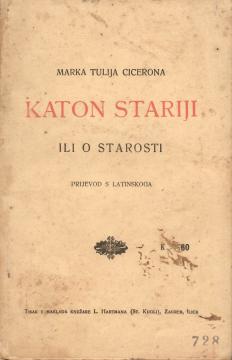
Katon Stariji ili O starosti

Marko Tulije Ciceron

Second, revised edition of the Croatian translation of the famous work Cato Maior de Senectute (44 BC). A philosophical dialogue in which Cato the Elder refutes prejudices about old age and celebrates its advantages.

The work Cato the Elder or On Old Age is one of Cicero's most famous philosophical writings from the so-called “last period” (44 BC). It is written in the form of a dialogue in which the 84-year-old Marcus Porcius Cato the Elder (Cato Maior) speaks to his younger friends Scipio Aemilianus and Laelius. Cicero put his ideas about old age into the mouth of a distinguished Roman statesman in order to give them greater authority and moral weight.

The main theme is the defense of old age against the usual accusations: that it is difficult, poor in bodily pleasures, close to death and useless. Cato (or Cicero) argues the opposite — old age brings wisdom, peace of mind, freedom from passions, the opportunity for intellectual work and respect in society. The work is optimistic and practical: it advises an active life, cultivating the mind, engaging in agriculture, literature and politics, and preparing for death with dignity. One of the most famous quotes is that “the life of an old man is not weak, but mature”.

The Croatian edition from 1911 is a classic school and popular translation. It was translated by Adolf Tkalčević, a famous philologist and translator from Latin, and the translation was linguistically modernized by Milan Žepić. The booklet is very short, intended for a wider audience and school use during the Austro-Hungarian era. The style of the translation is classical, clear and dignified, typical of Croatian philologists from the early 20th century.

In a broader context, this work belongs to Cicero's ethical writings (De senectute, De amicitia, De officiis), written in a time of political impotence after Caesar's assassination. Cicero wanted to console himself and his contemporaries with it, and at the same time promote the Stoic-Roman ideal of dignified old age. The work was extremely popular in European literature and humanism throughout the centuries — it was read and praised by Petrarch, Voltaire and many others.

In Croatian culture, this translation testifies to the strong classical tradition and the importance of the Latin language in education and intellectual life. Today it is considered an antiquarian rarity, and the work is still read as a classic text about aging, wisdom and accepting the end of life. It represents one of the most beautiful and most comforting writings of ancient philosophy.

Translation
Adolf Tkalčević, Milan Žepić
Editor
Milan Žepić
Dimensions
19 x 12 cm
Pages
46
Publisher
Knjižarnica Lavoslava Hartmana, Zagreb, 1911.
 
Latin alphabet. Paperback.
Language: Croatian.

One copy is available

Condition:Used, excellent condition
 

Are you interested in another book? You can search the offer using our search engine or browse books by category.

You may also be interested in these titles

Subjektivnost i istina: Predavanja na Collège de France, 1980.–1981.

Subjektivnost i istina: Predavanja na Collège de France, 1980.–1981.

Michel Foucault

Foucault explores how in antiquity subjectivity and truth were linked through the relationship to the body, pleasures, and self-care, and how this connection gradually changed towards the Christian model of confession.

Sandorf, 2019.
Croatian. Latin alphabet. Paperback.
19.00
Gorgija: O sofistima

Gorgija: O sofistima

Platon

Plato's dialogue Gorgias (c. 380 BC) in which Socrates debates with Gorgias, Polus, and Callicles about the nature of rhetoric, power, justice, and the good life. A harsh criticism of the Sophists and their oratory as flattery rather than knowledge.

Kontrast, 2025.
Serbian. Latin alphabet. Paperback.
10.00
Umeće ratovanja

Umeće ratovanja

Sun Tzu

The Art of War is a Chinese military treatise written in the 6th century BC by Sun Tzu. Consisting of 13 chapters, it has long been hailed as the finest work of military strategy and tactics of its time.

Riznica, 2012.
Serbian. Latin alphabet. Paperback.
9.00
Filozofija kao način življenja: Razgovor sa Žani Karlije i Arnoldom I. Dejvidsonom

Filozofija kao način življenja: Razgovor sa Žani Karlije i Arnoldom I. Dejvidsonom

Pierre Hadot

In the book of interviews, Pierre Hadot explains through his personal life story and conversations with Jeannie Carlier and Arnold I. Davidson why ancient philosophy was above all a way of life and a spiritual exercise, and not just theoretical knowledge.

Fedon, 2011.
Serbian. Latin alphabet. Paperback with dust jacket.
17.32
Metafizika

Metafizika

Aristotel

Metaphysics is Aristotle's most famous and influential philosophical work, consisting of 14 books. The name Metaphysics is not Aristotle's – it came later because the writings were placed "behind physics" (meta ta physika).

Medicinska naklada, 2001.
Croatian. Latin alphabet. Hardcover.
18.00
Veština pamćenja

Veština pamćenja

Frances A. Yates

The Art of Memory (1966), one of the most significant works of intellectual history, explores the history of mnemonics from ancient Greece and Rome, through the Middle Ages and the Renaissance, to its influence on the science and culture of Europe.

Mediterran Publishing, 2013.
Serbian. Latin alphabet. Paperback.
19.34