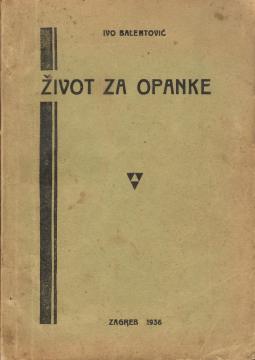
Život za opanke

Život za opanke

Ivo Balentović

The first literary work by Ivo Balentović, in which, through stories from Slavonian, Šokac rural life, he depicts the difficult fate of peasants, the penetration of capitalism into the countryside, emigration and the struggle for survival.

Life for Opanke is a collection of short stories that Ivo Balentović (1913–2001), born in Županjac, published in 1936 as his literary debut (self-published). This established him as one of the representatives of interwar Slavonian prose, alongside authors such as Josip Kozarac or Slavko Kolar. Balentović was only 23 years old at the time, and the collection immediately received positive reviews because it brought a fresh, authentic portrayal of life in Posavina.

The book consists of several short stories and short stories that draw material from rural Slavonia – from the Šokac villages along the Sava River. The title Life for Opanke is symbolic: the opanke represent traditional, poor peasant life, hard work on the land, attachment to tradition and the struggle for bare survival at a time when the village was beginning to experience profound changes under the influence of capitalism and modernization.

Balentović writes realistically, with a strong social commitment, but also with a lyrical, emotional tone. His characters are peasants, laborers, young people who go to America or the cities, women who carry the burden of their families, the elderly who preserve old customs. He describes poverty, hunger, injustice, conflicts between the old and the new, the exploitation of peasants by merchants and moneylenders, but also the warmth of family ties, Šokac weddings, customs and the beauty of the landscape along the Sava. The prose is sentimental-serial, with an emphasis on the psychology of the characters and social criticism.

This collection marks the beginning of Balentović's long literary journey. Later, he wrote about thirty more books - novels, collections of stories, poetry, travelogues, children's books and non-fiction. He lived in Županja, Zagreb, Istria (Umag), translated from Bulgarian and other languages, edited the newspaper Susreti and remained faithful to the themes of the Slavonian and Istrian regions.

Life for Opanka is today considered an important document of Croatian regional literature of the 20th century, a testimony to life in Posavina on the eve of World War II. The work is authentic, warm and nostalgic, and at the same time critically aware. The collection remains a witness to a disappearing world of Šokac villages and their “opanaks”.

Dimensions
19 x 13 cm
Pages
88
Publisher
Vlastita naklada, Jastrebarsko, 1936.
 
Latin alphabet. Paperback.
Language: Croatian.

One copy is available

Condition:Used, very good condition
Damages or inconvenience notice:
  • Yellowed pages
 

Are you interested in another book? You can search the offer using our search engine or browse books by category.

You may also be interested in these titles

Liga ribara

Liga ribara

Marija Andrijašević

The League of Fishermen brings together everything that makes us read Marija Andrijašević: complex characters, flexible and sumptuous language, convincing dialogues and stories that will hook you with discreet humor.

Oceanmore, 2024.
Croatian. Latin alphabet. Paperback.
11.98
Što je muškarac bez brkova: humoristički roman

Što je muškarac bez brkova: humoristički roman

Ante Tomić

When it was first published in 2000, Tomić's novel What is a Man Without a Mustache instantly became a bestseller, and over the next few years it went through a series of new editions, dramatizations, and a film adaptation. First edition.

Hena Com, 2000.
Croatian. Latin alphabet. Paperback.
15.24
Rudnik čvaraka

Rudnik čvaraka

Tomislav Šovagović

The debut work of Croatian writer Tomislav Šovagović, awarded the Josip and Ivan Kozarac Award in 2012, is a dedication to Slavonia – the region of his childhood that the author, born in Dalmatia, observes with foreign but tender eyes.

Mozaik knjiga, 20112.
Croatian. Latin alphabet. Paperback.
11.56
Zagrepčanka

Zagrepčanka

Branislav Glumac

Branislav Glumac published a novel without periods or commas in 1974, as the relentless stream of thought of a young rebel. Published in socialist Yugoslavia, the work caused a scandal with its openness and became a classic about generational rebellion.

IROS, 1986.
Croatian. Latin alphabet. Hardcover.
8.24
Savršen otok: mala kronika jednog obiteljskog ljetovanja

Savršen otok: mala kronika jednog obiteljskog ljetovanja

Sanja Lovrenčić

The Perfect Island is written as a chronicle of a summer vacation. Family harmony comes to the fore in the challenges of unfamiliar surroundings, encounters with new people, and mutual conversations.

Kašmir Promet, 2002.
Croatian. Latin alphabet. Hardcover.
5.32
Mama Leone

Mama Leone

Miljenko Jergović

Jergović's stories ironically depict a childhood and an upbringing. The only reality of this autobiographical prose is moving from place to place and from country to country. Strength and beauty are found in the subtle threads with which he weaves his ima

Durieux, 1999.
Croatian. Latin alphabet. Paperback.
8.56