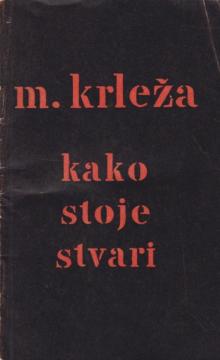
Kako stoje stvari: Predavanje održano u Domu JNA u Zagrebu 17. 12. 1952.

In his lecture How Things Are (1952), Krleža discusses the political and cultural situation of post-war Yugoslavia, emphasizing the need for critical thought, cultural renewal, and resistance to dogmatism.
“How Things Are” is a transcript of Krleža’s lecture given on December 17, 1952, at the Yugoslav People’s Army House – a speech set in a period of intense political and cultural turmoil following the breakup with the Informbiro. Krleža addresses the audience as a writer, intellectual, and participant in the times, with the intention of explaining what cultural and political work means in a country that is just trying to rebuild itself from the ruins of war and ideological fractures.
Krleža analyzes the state of society without pathos: he speaks of the necessity to break with dogmas, empty phrases, and bureaucratic automatisms that stifle the creative spirit. He emphasizes the importance of education, critical awareness, and cultural openness, contrasting them with the mentality of the “ideological shelf” and the routine that turns the revolution into a mere administrative mechanism. His rhetoric is forceful, but not propagandistic; he insists on the responsibility of intellectuals and the need for society to develop a culture of dialogue, not blind compliance.
The text, like most of Krleža's public speeches, is full of historical references, irony and broad cultural observations. The speech does not hide the tensions of the times: Krleža speaks about the dangers of introversion, the consequences of fanaticism and the meaning of "new delusions" that can appear where thought turns into dogma. At the same time, the text also carries a strong optimistic element - the belief that it is possible to build a society based on knowledge, creativity and freedom of ideas.
As things stand, therefore, it remains an important document of the times and a unique combination of political speech and essay: Krleža's view of the state of society from the perspective of a writer who does not accept simple truths and who believes that culture is the foundation of all true renewal.
One copy is available