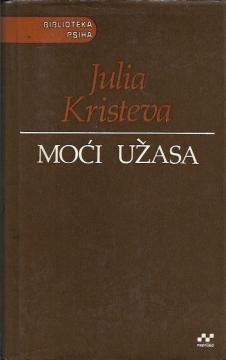
Moći užasa: Ogled o zazornosti
In The Powers of Horror, Julia Kristeva explores the concept of disgust – that which causes disgust and anxiety because it destroys the boundaries between self and other, purity and impurity, life and death.
In the book Powers of Horror: An Essay on Abomination (1980), philosopher and psychoanalyst Julia Kristeva develops a theory of the abomination as a fundamental boundary of identity and cultural order. The abomination is that which provokes repulsion, but also fascination – that which we repress because it threatens to destroy the boundary between “self” and “other”, pure and impure, life and death. Examples of the abomination are the body, blood, excretions, decomposition – anything that recalls human fragility and death. Kristeva explores how culture, religion and language shape the mechanisms by which the abomination is repressed in order to maintain order and subjective identity. She particularly analyses the relationship between mother and child, where the abomination appears as a transition from bodily symbiosis to symbolic, linguistic identity. The Powers of Horror brings together psychoanalysis, anthropology and aesthetics, offering a profound interpretation of language, the body and the fear of the disintegration of the subject.
"Why misery? Why is there this “something” that is neither subject nor object, but keeps coming back, rebelling, fascinating? It is not neurosis. We glimpse it in phobia, psychosis. It is the explosion that Freud touched upon, but perhaps avoided, and that psychoanalysis should be ever more eager to hear. Because history and society impose it on us. In horror. Do rituals, religions, art do nothing but repel disgust? Hence the strange revelation of literature: Dostoevsky, Lautréamont, Proust, Artaud and, very symptomatically, Céline. Here he is now, this inhabitant of the borders, without desire and place of his own, wandering, pain and laughter mixed together, a disgusted wanderer in a filthy world. This is the object of resentment."
No copies available
The last copy was sold recently.