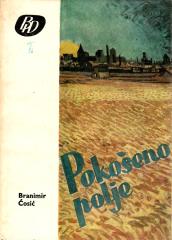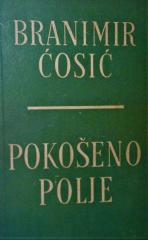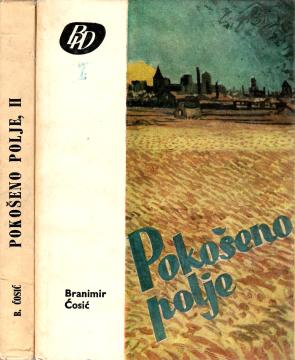
Pokošeno polje

Pokošeno polje

Branimir Ćosić

Mown Fields (1933) represents the culmination and swan song of a life that ended too soon – the author finished the novel just five months before his death from tuberculosis, at the age of thirty-one.

A book deeply imbued with personal pain and a broad picture of a broken time, where war trauma and post-war decadence intertwine into a difficult, inevitable whole. The first part of the novel bears a strong autobiographical imprint: through the eyes of a child and a young man, the horrors of World War I are brought to life – hunger, occupation, a devastated village, the loss of family and innocence. It is a world in which youth is mown down like a field under a mower, where national pride mixes with humiliation, and everyday life becomes a struggle for bare survival. Ćosić does not romanticize suffering; it is raw, tangible, leaving deep scars that never heal.

The second part shifts to Belgrade in the interwar years – a city of corruption, false ideals, moral collapse and existential emptiness. The main character, a journalist and intellectual, wanders through a gallery of failed characters: cynics, opportunists, petty bourgeois who have adapted to the new order. Ćosić’s criticism is harsh, but not pamphlet-like – it comes from within, from the disappointment of a generation that survived the war to witness the disintegration of all the values ​​it fought for. Love, friendship, faith in a better tomorrow – everything crumbles under the weight of time.

The style of the novel is urban, modern, psychologically profound, with a fragmentary flow that reflects inner unrest. There is no pathos, no embellishment; Ćosić writes with bare, almost documentary precision, but with warmth towards the disenfranchised and wounded. The title – a mowed field – is not just a metaphor for destroyed youth; it is an image of an entire era, where life is mowed before it blooms.

Dimensions
17 x 12 cm
Pages total
499
Publisher
Svjetlost, Sarajevo, 1961.
 
Latin alphabet. Hardcover.
Language: Serbian.

The book consists of two volumes.

Jedan višetomni primjerak je u ponudi.
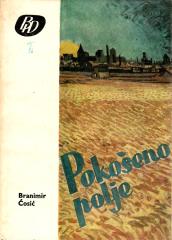
Pokošeno polje
Volume 1
Pages: 187
Condition:Used, excellent condition
Pokošeno polje
Volume 2
Pages: 312
Condition:Used, excellent condition
 

Are you interested in another book? You can search the offer using our search engine or browse books by category.

You may also be interested in these titles

Pokošeno polje

Pokošeno polje

Branimir Ćosić

Mowed Field is the most significant and last novel by the Serbian writer Branimir Ćosić (1903–1934), completed in 1933, just five months before his death from tuberculosis at the age of 31.

Nakladni zavod Hrvatske, 1949.
Serbian. Latin alphabet. Hardcover.
5.50
Ranjeni pejzaž

Ranjeni pejzaž

Vladimir Mičetić

A book by Vladimir Mičetić, a doctor and volunteer of the Homeland War from Kutina. The work was awarded the literary prize "We Were the First When It Was Necessary" for 2010, awarded by the Association of Croatian Homeland War Veterans.

Spiritus Movens, 2010.
Croatian. Latin alphabet. Hardcover.
11.52
Zbogom oružje

Zbogom oružje

Ernest Hemingway

Hemingway's novel A Farewell to Arms (1929), set on the Italo-Austrian front, follows the love story and wartime experiences of Frederic Henry, an American lieutenant who serves as an ambulance driver in the Italian army during World War I.

Matica srpska, 1985.
Serbian. Latin alphabet. Hardcover.
4.72
Armageddon

Armageddon

Leon Uris

Armageddon (1964) by Leon Uris is a historical novel set in post-war Berlin during the 1948-1949 airlift, when the Allies supplied West Berlin amidst the Soviet blockade.

Otokar Keršovani, 1970.
Croatian. Latin alphabet. Hardcover with dust jacket.
8.26
Sanjaj nemogući san

Sanjaj nemogući san

Johannes Mario Simmel

From the bestselling author of "Jimmy and the Rainbow," comes a novel that weaves a love story with the stirring events of the Bosnian war. This story, woven into the historical context, reminds us that sometimes the impossible dream is the only one worth

Mozaik knjiga, 1997.
Croatian. Latin alphabet. Hardcover.
7.425.94
Baraka Pet Be i druge novele

Baraka Pet Be i druge novele

Miroslav Krleža

The collection "Baraka Pet Be i druge novele" brings a selection of Krleža's anti-war novels from the period 1916–1920s, focusing on the senselessness of World War I, the suffering of the Home Guard and the downfall of Austria-Hungary.

Mladost, 1987.
Croatian. Latin alphabet. Hardcover.
5.38