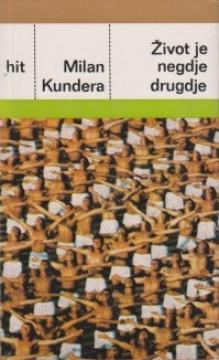
Život je negdje drugdje

Život je negdje drugdje

Milan Kundera

Jaromil, a young poet raised by a possessive mother, seeks a "real life" in poetry and revolution. His lyrical youth, love, and idealism lead him into conformity and betrayal of intimate relationships – he dies young and unfulfilled.

Life is Elsewhere is a satirical and philosophical novel by Milan Kundera, written in 1969, first published in French in 1973 (Kundera was already in exile at the time). The novel is a portrait of the artist as a young man – the lyric poet Jaromil, whose life is marked by his mother's obsessive love and his search for a "real life" that is always "somewhere else".

The plot spans from the 1930s to the early 1950s in Czechoslovakia: Jaromil's birth (his mother gives birth to him despite his father's request for an abortion), his childhood under his mother's influence (she sees him as a genius, sticks his verses on the wall), puberty with masturbation and fantasies about Xavier (an ideal alter ego), first loves (a red-haired saleswoman, a married woman) and finally his political involvement in the communist revolution of 1948–1949.

The mother (called Maman) is the central figure – possessive, romantic, lives through her son, rejects reality and drives Jaromil into a lyrical illusion. Jaromil, insecure and narcissistic, uses poetry as an escape from real life: he writes pathetic verses, dreams of revolution as an aesthetic act, but when the revolution wins, he becomes a conformist – betrays his friends, reports his mistress to the police out of jealousy and fear. His “lyrical age” (youth) is at once romantic and dangerous: lyricism merges with totalitarianism, poetry becomes propaganda.

The novel is divided into sections (the birth of the poet, Xavier, masturbation, mother, revolution, etc.), with Kundera’s typical ironic, essayistic digressions on art, love, politics and youth. The book criticizes romantic lyricism (Rimbaud, Shelley) which leads to political fanaticism – Jaromil is a caricature of a poet-revolutionary who sacrifices the intimate for the grandiose. There are no heroes: Jaromil is pathetic, the mother is pathetic, the revolution is fake.

The style is sharp, witty, erotic, with long philosophical passages – Kundera dissects youth as a "lyrical age" full of lies and self-deception. The novel is an early Kundera, part of the Czech cycle (along with The Joke, Funny Loves), but it announces later themes of alienation and false existence. In Croatian translation it remains one of Kundera's most appreciated novels – a bitter portrait of how idealism easily turns into cynicism and betrayal.

Naslov izvornika
Život je jinde
Prijevod
Nikola Kršić
Urednik
Zlatko Crnković
Naslovnica
Alfred Pal
Dimenzije
19 x 11 cm
Broj strana
265
Nakladnik
Znanje, Zagreb, 1979.
 
Latinica. Tvrde korice s ovitkom.
Jezik: Hrvatski.

Jedan primjerak je u ponudi

Stanje:Korišteno, u dobrom stanju (tragovi korištenja)
Oštećenja / nepogodnosti:
  • The cover is missing
  • Worn covers
Dodano u košaricu!
 

Zanima Vas i neka druga knjiga? Možete pretražiti našu ponudu pomoću tražilice ili prelistati knjige po kategorijama.

Možda će Vas zanimati i ovi naslovi

Konačna dijagnoza

Konačna dijagnoza

Arthur Hailey

Arthur Hailey's Final Diagnosis is a medical novel set in a large hospital. Through the fates of doctors and patients, it depicts responsibility, professional errors, and the conflict between tradition and progress in medicine.

Znanje, 1972.
Hrvatski. Latinica. Tvrde korice s ovitkom.
4,42
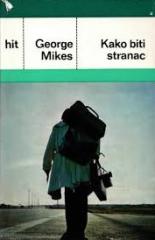
Kako biti stranac

Kako biti stranac

George Mikes

How to Be a Foreigner by George Mikes is a humorous book in which the author, as an immigrant from Hungary, humorously describes British customs, mentality, and everyday life from the perspective of a foreigner.

Znanje, 1980.
Hrvatski. Latinica. Tvrde korice s ovitkom.
5,42
Kronika kulta ličnosti

Kronika kulta ličnosti

Jevgenija Ginzburg

Chronicle of the Cult of Personality by Yevgenia Ginzburg is a memoir about the Stalinist purges. The author describes her own arrest, imprisonment, and years spent in camps, testifying to the repression of the Soviet regime.

Znanje, 1971.
Hrvatski. Latinica. Tvrde korice s ovitkom.
6,48
Grupa

Grupa

Mary Mccarthy

Mary McCarthy's group follows eight young women after they graduate from Vassar. The novel depicts their loves, marriages, careers, and disappointments, as well as the position of women in American society in the 1930s.

Znanje, 1987.
Hrvatski. Latinica. Tvrde korice s ovitkom.
5,324,26 - 6,60
Duše robova

Duše robova

Ivan Aralica

Ivan Aralica's Souls of Slaves is a historical novel depicting the life of the Croatian people under Ottoman rule. The work explores issues of freedom, identity, religion, and human dignity.

Znanje, 1988.
Hrvatski. Latinica. Tvrde korice s ovitkom.
5,30
Bogataš i siromah

Bogataš i siromah

Irwin Shaw

Rich Man and Pauper by Irwin Shaw is a family novel that follows the lives of three children in the Jordache family. The work explores success, failure, social differences, and the pursuit of happiness.

Znanje, 1974.
Hrvatski. Latinica. Tvrde korice s ovitkom.
5,62