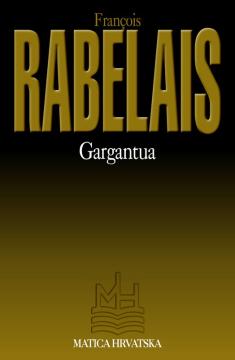
Gargantua
Retka knjiga

Gargantua

François Rabelais

The birth, childhood, upbringing and warlike exploits of the giant Gargantua: a satire on scholasticism, wars, monasticism and society, with grotesque humour, enormous eating/drinking and utopian ideals.

Gargantua (1534/1535) by François Rabelais (ca. 1494–1553) is the first (and most famous) part of the pentalogy about the giants Gargantua and Pantagruel. This edition by Matica Hrvatska brings the first complete translation of the book into Croatian, independently - later Pantagruel was published in 1996, the other books in 1997–1998, and the whole in 2004.

The novel begins with the genealogy and birth of Gargantua (from the ear of his mother Gargamela after an enormous feast), his childhood full of grotesque episodes (drinking rivers of wine, enormous quantities of food), then his poor scholastic upbringing in Paris (a satire on medieval education) and the transition to humanistic education under Ponocrates. It culminates in a war against King Picrochol (a parody of modern wars), where Gargantua fights victoriously, and the reward is the founding of the utopian monastery of Teljem – "Do what you will" (Fay ce que vouldras), where freedom, education and harmony are the opposite of ascetic monasticism.

Rabelais's style is furious, exuberant, full of vulgarisms, puns, lists, parodies of the Bible, ancient authors and medieval genres. Grotesque bodies (giant functions, eating, sex) serve to satire the Church, belligerence, scholasticism and social norms of the Renaissance. The work is humanistic, optimistic, celebrates life, knowledge and freedom, but also cynically mocks hypocrisy. Maras's translation is commendable for preserving the rhythm, humour and linguistic inventiveness of the original.

Naslov originala
La vie très horrificque du grand Gargantua
Prevod
Mate Maras
Urednik
August Kovačec
Naslovnica
Luka Gusić
Dimenzije
16,7 x 11 cm
Broj strana
216
Izdavač
Matica hrvatska, Zagreb, 1996.
 
Latinica. Broširano.
Jezik: Hrvatski.

Jedan primerak je u ponudi

Stanje:Korišćeno, u odličnom stanju
Oštećenja / nepogodnosti:
  • Slight damage to the cover
Dodato u korpu!
 

Zanima Vas i neka druga knjiga? Možete pretražiti našu ponudu pomoću pretrage ili prelistati knjige po kategorijama.

Možda će Vas zanimati i ovi naslovi

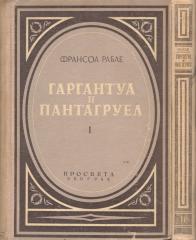
Gargantua i Pantagruel

Gargantua i Pantagruel

François Rabelais

Rabelais' masterpiece, a five-book novel cycle that follows the adventures of the giant Gargantua and his son Pantagruel. Vinaver, known for his linguistic virtuosity, masterfully conveys Rabelais's lavish humor, juicy swear words, and layered wordplay.

Kultura, 1950.
Srpski. Ćirilica. Tvrde korice.
Knjiga se sastoji od dva toma
11,34
Crna lala

Crna lala

Alexandre Dumas

Cornelius van Berle, a young doctor from Dortrecht, is obsessed with creating a black tulip for the prize of the city of Harlem.

Nolit, 1966.
Srpski. Latinica. Tvrde korice.
2,98
Robin Hood

Robin Hood

Alexandre Dumas

Dumas portrays Robin Hood not only as a bandit who helps the poor, but also as a heroic fighter for justice and a symbol of resistance to feudal injustice.

Epoha, 1966.
Hrvatski. Latinica. Tvrde korice s omotom.
4,26 - 4,82
Posada

Posada

Joseph Kessel

The novel is considered one of Kessel's most significant works, inspired by his experiences as a pilot during World War I.

Minerva, 1987.
Srpski. Latinica. Tvrde korice.
4,38
Gospođica Chambon

Gospođica Chambon

Éric Holder

Miss Chambon is the story of the meeting of Antonio, a Portuguese mason, and Véronique Chambon, his son's teacher. Antonio and Véronique love and want each other, but in silence and in their thoughts. They see each other, talk, but do not mention the feel

V.B.Z, 2004.
Hrvatski. Latinica. Tvrde korice.
4,26
Čovek od gipsa

Čovek od gipsa

Joseph Kessel

The novel, whose original title is L'Homme de plâtre, explores complex human destinies through the story of a protagonist whose life symbolically reflects fragility and vulnerability, like plaster.

Minerva, 1987.
Srpski. Latinica. Tvrde korice.
4,64