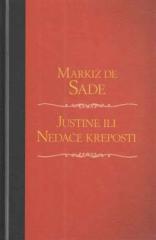
Justine ili nedaće kreposti

Justine ili nedaće kreposti

Markiz Donatien de Sade

The novel follows the young, virtuous Justine who, after losing her parents, runs away from a convent and suffers a series of horrific abuses, rapes, and humiliations because she rejects crime and vice. Virtue is punished, vice is rewarded.

The novel by the Marquis de Sade, first published anonymously in 1791 in Paris (later expanded versions in 1797 and 1801), is one of the most controversial works of world literature. The main character Justine (who introduces herself as Thérèse) is a young, beautiful, pious and naive girl who, after the death of her parents and the loss of her property, leaves the convent and tries to live an honest and virtuous life.

The novel is structured as a series of Justine's misfortunes: fleeing from evil, she falls into the hands of bandits, thieves, sadistic nobles, corrupt priests, pseudo-scientists and tyrants who rape, torture, humiliate and use her for their perverse pleasures. Every time she tries to help others or rely on morality, faith and justice, she is punished even more cruelly. Opposite her stands her sister Juliette (in the later novel Juliette, or the Prosperity of Vice), who chooses the path of vice and crime and achieves wealth and power.

Through the characters' philosophical discussions (atheistic, nihilistic, materialistic monologues), Sade presents a radical critique of Christian morality, providence and social norms: virtue is weakness, nature is amoral and favors the strong over the weak, and God does not exist or is cruel. The work is a philosophical pornographic treatise – it explicitly describes violence, incest, sodomy, torture and other extreme scenes to illustrate the thesis that vice is rewarded and virtue is condemned. Published at the time of the French Revolution, the novel caused a scandal, led to Sade's re-arrest and influenced later literature (romanticism, existentialism, surrealism).

Today it is considered a key work for understanding sadism (a term derived from Sade's name), but also a deep critique of the hypocrisy of society and religion. Because of the explicitness, it is not for everyone - warning of violence and sexual perversions.

Naslov originala
Justine ou les malheurs de la vertu
Prevod
Ivo Klarić
Urednik
Milan Mirić
Naslovnica
Ratko Janjić Jobo
Dimenzije
20,5 x 12,5 cm
Broj strana
286
Izdavač
Naprijed, Zagreb, 1984.
 
Latinica. Tvrde korice s omotom.
Jezik: Hrvatski.

Jedan primerak je u ponudi

Stanje:Korišćeno, u odličnom stanju
Dodato u korpu!
 

Zanima Vas i neka druga knjiga? Možete pretražiti našu ponudu pomoću pretrage ili prelistati knjige po kategorijama.

Možda će Vas zanimati i ovi naslovi

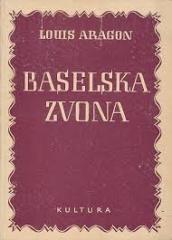
Baselska zvona

Baselska zvona

Louis Aragon

Der Roman erzählt die Geschichten dreier Frauen: Diane, einer Adligen; Catherine Simonidzé, einer Feministin; und der realen Clara Zetkin, einer Kommunistin. Anhand ihrer Schicksale werden die Krise der bürgerlichen Gesellschaft, die Emanzipation der Frau

Kultura, 1946.
Srpski. Latinica. Tvrde korice.
5,76
Ljubičice u srijedu

Ljubičice u srijedu

Andre Maurois

André Maurois, ein französischer Schriftsteller, der für seine psychologischen Romane und Biografien bekannt ist, behandelt in diesem für seinen Stil charakteristischen Werk Themen wie Familienbeziehungen, Liebe und innere Konflikte.

Svjetlost, 1965.
Hrvatski. Latinica. Broširano.
3,42 - 3,62
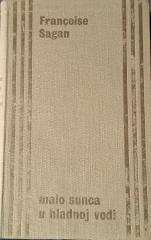
Malo sunca u hladnoj vodi

Malo sunca u hladnoj vodi

Françoise Sagan

„Eine kleine Sonne in kaltem Wasser“ (1971) ist ein Roman der französischen Autorin Françoise Sagan.

Naprijed, 1971.
Hrvatski. Latinica. Tvrde korice.
4,88
Za ljubav sina

Za ljubav sina

Herve Bazin

Ein intimes, autobiografisches Drama über Vaterschaft, Schuldgefühle und komplexe Familienbeziehungen. Die Hauptfigur ist Daniel, ein verwitweter Mann mittleren Alters, der drei Kinder allein erzieht: Zwillinge (einen älteren Sohn und eine Tochter) und de

Svjetlost, 1965.
Hrvatski. Latinica. Broširano.
2,76
A što ako vrijeme ne postoji?

A što ako vrijeme ne postoji?

Carlo Rovelli

Zehn Jahre bevor er die allgemeine Relativitätstheorie entdeckte, erkannte Einstein, dass Zeit und Raum nicht zwei getrennte Entitäten sind, sondern zwei Aspekte ein und derselben Entität.

Tim press, 2015.
Hrvatski. Latinica. Broširano.
6,785,42
Vrijeme nasilja

Vrijeme nasilja

Jean-Pierre Simon

„Eine Zeit der Gewalt“ (1966) ist ein Antikriegs- und Aktivistenroman des französischen Schriftstellers Jean-Pierre Simon, eines weniger bekannten Autors aus der Mitte des 20. Jahrhunderts, dessen Werk Spuren linker Literatur der 1930er und 1940er Jahre a

Svjetlost, 1965.
Hrvatski. Latinica. Broširano.
2,46