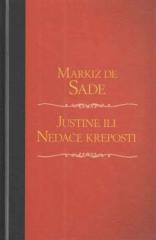
Justine ili nedaće kreposti

Justine ili nedaće kreposti

Markiz Donatien de Sade

The novel follows the young, virtuous Justine who, after losing her parents, runs away from a convent and suffers a series of horrific abuses, rapes, and humiliations because she rejects crime and vice. Virtue is punished, vice is rewarded.

The novel by the Marquis de Sade, first published anonymously in 1791 in Paris (later expanded versions in 1797 and 1801), is one of the most controversial works of world literature. The main character Justine (who introduces herself as Thérèse) is a young, beautiful, pious and naive girl who, after the death of her parents and the loss of her property, leaves the convent and tries to live an honest and virtuous life.

The novel is structured as a series of Justine's misfortunes: fleeing from evil, she falls into the hands of bandits, thieves, sadistic nobles, corrupt priests, pseudo-scientists and tyrants who rape, torture, humiliate and use her for their perverse pleasures. Every time she tries to help others or rely on morality, faith and justice, she is punished even more cruelly. Opposite her stands her sister Juliette (in the later novel Juliette, or the Prosperity of Vice), who chooses the path of vice and crime and achieves wealth and power.

Through the characters' philosophical discussions (atheistic, nihilistic, materialistic monologues), Sade presents a radical critique of Christian morality, providence and social norms: virtue is weakness, nature is amoral and favors the strong over the weak, and God does not exist or is cruel. The work is a philosophical pornographic treatise – it explicitly describes violence, incest, sodomy, torture and other extreme scenes to illustrate the thesis that vice is rewarded and virtue is condemned. Published at the time of the French Revolution, the novel caused a scandal, led to Sade's re-arrest and influenced later literature (romanticism, existentialism, surrealism).

Today it is considered a key work for understanding sadism (a term derived from Sade's name), but also a deep critique of the hypocrisy of society and religion. Because of the explicitness, it is not for everyone - warning of violence and sexual perversions.

Naslov originala
Justine ou les malheurs de la vertu
Prevod
Ivo Klarić
Urednik
Milan Mirić
Naslovnica
Ratko Janjić Jobo
Dimenzije
20,5 x 12,5 cm
Broj strana
286
Izdavač
Naprijed, Zagreb, 1984.
 
Latinica. Tvrde korice s omotom.
Jezik: Hrvatski.

Jedan primerak je u ponudi

Stanje:Korišćeno, u odličnom stanju
Dodato u korpu!
 

Zanima Vas i neka druga knjiga? Možete pretražiti našu ponudu pomoću pretrage ili prelistati knjige po kategorijama.

Možda će Vas zanimati i ovi naslovi

Justine ili nedaće kreposti

Justine ili nedaće kreposti

Markiz Donatien de Sade

"Justine or the Misadventures of Virtue" is a novel by the Marquis de Sade, first published in 1791.

Globus, 2004.
Hrvatski. Latinica. Tvrde korice.
4,62 - 4,98 €
Vrijeme nasilja

Vrijeme nasilja

Jean-Pierre Simon

Vrijeme nasilja (1966.) je antiratni i angažirani roman francuskog pisca Jean-Pierrea Simona, manje poznatog autora iz sredine 20. stoljeća, čije djelo nosi tragove ljevičarske literature 1930-ih i 1940-ih.

Svjetlost, 1965.
Hrvatski. Latinica. Broširano.
2,46 €
Tajna svijećnjaka

Tajna svijećnjaka

Miriam Delly

Roman „Tajna svećnjaka“ M. Deli prati devojku koja kroz intrige, ljubav i iskušenje otkriva istinu o misterioznom svećnjaku – simbolu porodičnih tajni i iskupljenja kroz ljubav i veru.

Nakladni zavod Matice hrvatske, 1989.
Hrvatski. Latinica. Tvrde korice s omotom.
6,74 €
Legenda o lijepom Pécopinu i lijepoj Bauldouri

Legenda o lijepom Pécopinu i lijepoj Bauldouri

Hugo
Victor Hugo

Eine romantische Erzählung von Victor Hugo, der 21. Brief aus seinem Reisebericht „Le Rhin“ („Der Rhein“, 1842). Ein romantischer Klassiker, ähnlich den Märchen der Brüder Grimm oder Andersen, jedoch geprägt von Hugos tiefer Emotionalität und seiner Philo

Zora, 1951.
Hrvatski. Latinica. Broširano.
3,34 €
Crveni krin

Crveni krin

Anatole France

Die rote Lilie (1894) ist nicht nur eine Geschichte verbotener Leidenschaft – sie ist ein subtiles, ironisches Fresko einer Welt, in der Liebe, Politik und Kunst in einem dünnen, fast transparenten Netz aus Konventionen und Begierden miteinander verwoben

Svjetlost, 1961.
Srpski. Latinica. Tvrde korice.
2,34 - 4,26 €
Gargantua

Gargantua

François Rabelais

Rođenje, detinjstvo, odrastanje i ratni podvizi diva Gargantue: satira o sholastici, ratovima, monaštvu i društvu, sa grotesknim humorom, ogromnim jelom/pićem i utopijskim idealima.

Matica hrvatska, 1996.
Hrvatski. Latinica. Broširano.
8,32 €