Hajduk Nikola Šuhaj
Rijetka knjiga

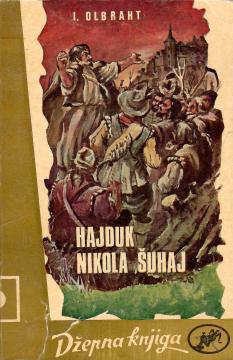
Hajduk Nikola Šuhaj

Ivan Olbracht

Hajduk Nikola Šuhaj (1933) is the most famous novel by Ivan Olbracht (real name Kamil Zeman, 1882–1952), a classic of 20th-century Czech literature. One of the most important works of Czech literature between the two wars.

The novel is set in Subcarpathian Russia (today Ukraine, Transcarpathian Oblast) after World War I and the collapse of Austria-Hungary. The main character Nikola Šuhaj, a young peasant from the village of Kolochava, returns from the front. Due to poverty, injustice from landowners and the authorities, and the impossibility of a normal life, he becomes a hajduk – a bandit. He begins to rob rich Jews, merchants and Chetniks, but distributes the money to poor peasants, which makes him a folk hero and the Robin Hood of the Carpathians.

Olbracht subtly depicts social contrasts: the poverty of the Ruthenian peasants, corruption of the authorities, anti-Semitism and exploitation. Nikola is not idealized – he is brave, but also violent, and his life is full of danger. The novel culminates in betrayal: in 1921, his comrades kill him for a reward, and his head is cut off and displayed as a trophy.

The style is realistic with elements of folk legend and ballad: the author uses folklore motifs, dialectal expressions and an epic tone, creating a myth about a righteous bandit. The work is anti-war and socially critical, but without agitation - the emphasis is on the tragic fate of the individual in the chaos of post-war society.

The novel was a great success, was screened several times (eg the movie "Nikola Šuhaj loupežník" in 1978, directed by Jiří Sequens), and became part of the folk mythology of Transcarpathia. In Yugoslavia, it was popular in post-war editions, appreciated for its humanism and realistic portrayal of peasant life.

Naslov izvornika
Nikola Šuhaj loupežník
Prijevod
Zora Simić
Urednik
Risto Trifković
Naslovnica
Mirko Stojnić
Dimenzije
16,5 x 11 cm
Broj strana
213
Nakladnik
Svjetlost, Sarajevo, 1965.
 
Latinica. Broširano.
Jezik: Hrvatski.

Jedan primjerak je u ponudi

Stanje:Nekorišteno
Dodano u košaricu!
 

Zanima Vas i neka druga knjiga? Možete pretražiti našu ponudu pomoću tražilice ili prelistati knjige po kategorijama.

Možda će Vas zanimati i ovi naslovi

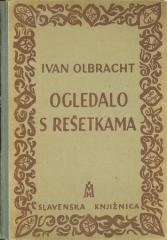
Ogledalo s rešetkama

Ogledalo s rešetkama

Ivan Olbracht

"Mirror with bars" by Ivan Olbracht is a novel that deals with the themes of identity, love and social norms through the story of the life and internal conflicts of the main character, Milan. (Author's real name: Kamil Zeman.)

Matica hrvatska, 1946.
Hrvatski. Latinica. Tvrde korice.
2,99 - 4,76
Ulica mačka ribara

Ulica mačka ribara

Jolán Földes

The novel tells about the difficult life of a working-class family of Hungarian emigrants in Paris after the First World War. In 1936, he won the All Nations Prize for a novel by Pinter Publishing Ltd (London). Rarely offered with cover.

Binoza, 1937.
Hrvatski. Latinica. Tvrde korice s ovitkom.
15,74
Hronika o siromašnim ljubavnicima

Hronika o siromašnim ljubavnicima

Vasco Pratolini

In Florence 1925–1926, in the poor Via del Corno, the residents live in love, poverty and fear. The arrival of fascism destroys the community: lovers fight, some die from violence, but popular solidarity survives.

Svjetlost, 1966.
Srpski. Latinica. Broširano.
Knjiga se sastoji od dva toma
4,56
Krvava arena

Krvava arena

Vicente Blasco Ibanez

The Bloody Arena (1908) is a naturalistic novel about the rise and fall of bullfighter Juan Gallardo. A poor young man becomes a famous matador, but is destroyed by love, vice, fear, and tragedies in the arena – a critique of Spanish bullfighting and soci

Naprijed, 1984.
Hrvatski. Latinica. Tvrde korice s ovitkom.
4,76
Karlo i XX. stoljeće

Karlo i XX. stoljeće

Rudolf Brunngraber

The story of Karl Lakner, caught in the huge world machine of capitalism. A political and economic visionary novel by Rudolf Brunngraber from the 1930s.

Binoza, 1939.
Hrvatski. Latinica. Tvrde korice s ovitkom.
37,42
Pokošeno polje

Pokošeno polje

Branimir Ćosić

Mown Fields (1933) represents the culmination and swan song of a life that ended too soon – the author finished the novel just five months before his death from tuberculosis, at the age of thirty-one.

Svjetlost, 1961.
Srpski. Latinica. Tvrde korice.
Knjiga se sastoji od dva toma
5,34