Da mi je danas bilo ne susresti sebe

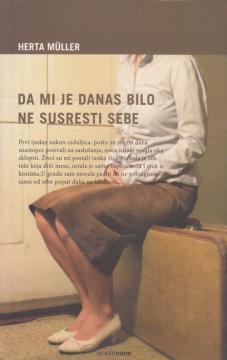
Da mi je danas bilo ne susresti sebe

Herta Müller

Dies ist der zweite in unserem Land veröffentlichte Roman der preisgekrönten Autorin, einer Rumänin, die seit 1987 in Berlin lebt und schreibt.

Apart from envious and treacherous colleagues in the clothing factory where she works, the main character is also tormented by the state's repressive apparatus, which summons her for questioning. The reason for this invitation is her desire to travel to one of the countries to which the factory exports clothes. In order to achieve this, she puts notes in the pockets of men's suits in which she is looking for a groom. The affair in the factory develops to a huge scale, even the main character is accused of prostitution and high treason...

"The first week after the slips, because I was called to the hearing for three days in a row, I couldn't close my eyes at night. My nerves became like a thin wire. The force of gravity that holds the flesh has disappeared, all that remains is tense skin and air in my bones. I'm in the city had to be careful not to run away on its own like a breath in the cold..."

In her works, the Romanian writer Herta Müller talks about aspects of her own life during the most primitive totalitarianism in Romania and about the feeling of alienation and lack of roots in the new soil that permeates all her characters of defectors and dissidents in exile. After the book spoke publicly against the dictatorship in Romania at the Frankfurt Fair, it was banned from further publication. After returning to her homeland, her life became more and more difficult, and in 1987 she moved to the west. Since then he lives in Berlin.

Original title
Heute wär ich mir lieber nicht begegnet
Translation
Helen Sinković
Editor
Gordana Farkaš-Sfeci
Dimensions
21 x 13 cm
Pages
184
Publisher
Oceanmore, Zagreb, 2009.
 
Latin alphabet. Paperback.
Language: Croatian.
ISBN
978-9-53705-669-8

No copies available

The last copy was sold recently.

 

Are you interested in another book? You can search the offer using our search engine or browse books by category.

You may also be interested in these titles

Crna kutija

Crna kutija

Amos Oz

The Black Box is a kaleidoscope of married life and love relationships. It is a novel that implicitly speaks about all of us.

Hena Com, 2001.
Croatian. Latin alphabet. Hardcover.
10.98
Deobe

Deobe

Dobrica Ćosić

Deobe is a novel about the tragic division of Serbs into Chetniks and Partisans during World War II. Winner of the NIN Award, it is part of a wider epic trilogy, inspired by Ćosić's experiences and historical documents.

Prosveta, 1963.
Croatian. Latin alphabet. Hardcover with dust jacket.
13.74
Štefica Cvek u raljama života

Štefica Cvek u raljama života

Dubravka Ugrešić

Do you like "lovelies"? Whatever you think about them, you'll enjoy this superb pastiche of trivial romance novels.

Mladinska knjiga, 1990.
Croatian. Latin alphabet. Hardcover with dust jacket.
4.94
V.

V.

Thomas Pynchon

The novel represents a journey into an alternative world – a world that we all belong to from time to time, but of which we would not want to be a part, a world of paranoia and alienation that we are not entirely sure is just an alternative or the bare tr

Čarobna knjiga, 2010.
Serbian. Latin alphabet. Paperback.
21.9817.58
Pripovetke iz levog i desnog džepa

Pripovetke iz levog i desnog džepa

Karel Čapek

These stories deal with different topics, although most deal with different criminal acts, from fraud and fortune-telling to marriage fraud and murder.

Jugoslavijapublik, 1980.
Croatian. Latin alphabet. Hardcover.
5.22
Zagrepčanka

Zagrepčanka

Branislav Glumac

Branislav Glumac published a novel without periods or commas in 1974, as the relentless stream of thought of a young rebel. Published in socialist Yugoslavia, the work caused a scandal with its openness and became a classic about generational rebellion.

IROS, 1986.
Croatian. Latin alphabet. Hardcover.
8.22 - 8.24