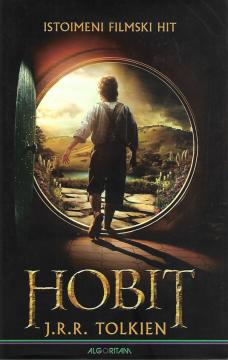
Hobit ili Tamo pa opet natrag

Hobit ili Tamo pa opet natrag
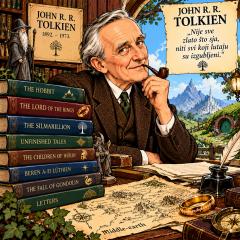
John R. R. Tolkien

The Hobbit was adapted for film on several occasions (1977, 1985 and in three sequels in 2012, 13 and 14), and computer games were also created based on the template.

The Hobbit is J. R. R. Tolkien's first book, conceived as a fantasy novel for children and adults. It was first published on September 21, 1937. Although it was conceived as a novel for children, it gained popularity among adults as well. He called the story "There and Back Again" and follows the adventures of the hobbit Bilbo Baggins and his companions. As the story gained great popularity, the audience asked for more, and the book The Lord of the Rings was published.

The action begins when the wizard Gandalf and 13 dwarves break into Bilbo Baggins' house: Thorin Oakenshield, Óin, Glóin (his son Gimli is one of the main characters in The Lord of the Rings), Dwalin, Balin (He was Gimli's cousin who occupied Khazad-Dum) , Bifur, Bofur, fat Bombur, brothers Fíli and Kíli, Dori, Nori and Ori). They persuade Bilbo to go on a journey with them, and they soon set off. Soon the group is captured by 3 Trolls, but the Trolls do not manage to hide from the sun and are petrified. The family takes parts of their treasure and goes to Rivendell. From there, they head to Mount Erebor to slay the dragon Smaug. After leaving Rivendell, they were captured by Goblins, but managed to escape. During his escape, Bilbo gets lost and finds the One Ring in the dark. With the help of the eagles, they manage to cross the Misty Mountains and arrive at the house of Beorn. After that, they go to Darkodol where they are captured by the king of the Darkodol elves, Thranduil. But they manage to escape again in wine barrels and reach Jezergrad. They stock up in Jezergrad and head for the mountain. Bilbo manages to steal the golden cup, and Smaug attacks Jezergrad in revenge. There the Bard from Down manages to kill the dragon. The group remains locked in the mountain, and the armies of people from Jezergrad, elves from Mrkodol, and dwarves from the Željezno gorje go for the treasure. The armies prepare to attack, but then they are attacked by Goblins from the Misty Mountains and they unite, and the eagles join the battle later. With heavy losses, the anti-goblin army wins and divides the treasure equally. That battle is also called the Battle of the Five Armies.

Original title
The hobbit
Translation
Zlatko Crnković
Editor
Neven Antičević
Illustrations
Igor Kordej
Graphics design
Igor Kordej
Dimensions
24 x 16 cm
Pages
270
Publisher
Algoritam, Zagreb, 2012.
 
Distribution: 2,000 copies
 
Latin alphabet. Hardcover with dust jacket.
Language: Croatian.
ISBN
978-9-53616-601-5

No copies available

The last copy was sold recently.
 

Are you interested in another book? You can search the offer using our search engine or browse books by category.

You may also be interested in these titles

Futura - Znanstvena fantastika & fantasy #51/1997

Futura - Znanstvena fantastika & fantasy #51/1997

Robert Silverberg, R. Garcia y Robertson, Charles Sheffield, Tatjana Jambrišak

Futura magazine was a Croatian magazine for speculative fiction, primarily for science fiction literature. The first issue of Futura was published in October 1992.

Bakal, 1997.
Croatian. Latin alphabet. Paperback.
3.28
Sirius: Biblioteka znanstvene fantastike - broj 89

Sirius: Biblioteka znanstvene fantastike - broj 89

Slobodan Ćurčić, Michael Shaara, Živko Prodanović, Philip K. Dick, Hojiakbar Shaikhov, Yashim Abd...

Sirius was a Croatian science fiction magazine. The foundation was proposed by Damir Mikuličić in 1976. In Sirius, the works of domestic authors, as well as translations of foreign SF authors, were published. It was published from 1976 to 1989.

Vjesnik, 1983.
Croatian. Latin alphabet. Paperback.
3.46
Futura - Znanstvena fantastika & fantasy #12/1993

Futura - Znanstvena fantastika & fantasy #12/1993

Murray Leinster, Andrew J. Offutt, Krunoslav Gernhard, Winston P. Sanders

Futura magazine was a Croatian magazine for speculative fiction, primarily for science fiction literature. The first issue of Futura was published in October 1992.

Bakal, 1993.
Croatian. Latin alphabet. Paperback.
3.26
Nevolje sa Tihoom

Nevolje sa Tihoom

Clifford Simak

The novel Nevolje sa Tiho was originally published in 1961 and in a sense marks the end of the first phase of Simak's creativity - namely, the one dominated by the "space opera" tradition.

Dnevnik, 1986.
Serbian. Latin alphabet. Paperback.
4.28
Futura - Znanstvena fantastika & fantasy #62

Futura - Znanstvena fantastika & fantasy #62

Mike Resnick, Richard Paul Russo, Wayne Wightman, Connie Willis, Milena Benini

Futura magazine was a Croatian magazine for speculative fiction, primarily for science fiction literature. The first issue of Futura was published in October 1992.

Bakal, 1997.
Croatian. Latin alphabet. Paperback.
3.62
Donji svetovi

Donji svetovi

Zvonimir Kostić
Prosveta, 1986.
Serbian. Latin alphabet. Paperback.
2.99