10 H.P. - Kronika našeg vremena
Rare book
Antique

10 H.P. - Kronika našeg vremena

Ilja Grigorjevič Erenburg

A complex and poignant account of the socio-historical events of the first half of the 20th century through personal reflections and experiences. Chronicle of Our Time is an important document of the era that combines literary power with historical testim

The work is a kind of autobiographical confession of an intellectual torn between art, ideology and the reality of wars, revolutions and political turmoil. The author witnesses turbulent times: the First World War, the October Revolution, the rise of Nazism and the Second World War, while sharply denouncing totalitarianism, anti-Semitism and the violation of human rights.

Ehrenburg does not offer a black and white picture, but through an introspective style criticizes both the East and the West, depicting moral dilemmas and the price of truth in a time of political repression. His attitude towards Stalin's regime, which he initially supported, but later became disillusioned with its methods, is particularly noteworthy.

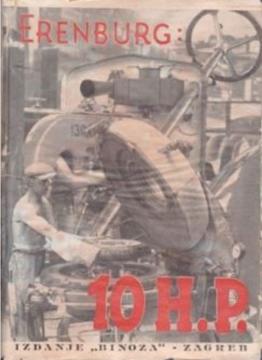
The first Croatian translation of 10 L.S. Khronika nashego vremeni (10 Л.С. Хроника нашего времени) by a Jewish Soviet writer and Bolshevik revolutionary, Ilya Grigoryevich Ehrenburg (1891-1967) was published in Zagreb in the early 1930s with a stunning dust jacket with a photomontage by an annonymous artist. The novel was written in Russian language in 1929 and first published in 1931. Binoza publishing house in Zagreb, was issuing in the early 1930s similar revolutionary modern original texts and translations, accompanied by striking modernist dustjackets, as Minerva in Zagreb, Croatia, and Nolit in Belgrade, Serbia. Unlike these two publishing houses, who were using the same artists for series of publications, Binoza was hiering designers and artists for individual publications and some of the covers, like this one, are not signed. The book is today very rare. The only example we could find outside Croatia is at the Bavarian State Library.

Original title
10 Л.С. Хроника нашего времени
Translation
Stjepan Kranjčević
Editor
Ivan Esih
Dimensions
20 x 15 cm
Pages
225
Publisher
Naklada Binoza, Zagreb, 1931.
 
Latin alphabet. Hardcover with dust jacket.
Language: Croatian.

No copies available

The last copy was sold recently.
 

Are you interested in another book? You can search the offer using our search engine or browse books by category.

You may also be interested in these titles

Briefe an Milena

Briefe an Milena

Franz Kafka

Briefe an Milena brings together Kafka's letters to Milena Jesenska, born of an intense spiritual and emotional closeness. The book reveals a love imbued with longing, fear, illness, and the impossibility of living together.

Fischer Bücherei / Fischer Taschenbuch Verlag, 1966.
German. Latin alphabet. Paperback.
2.00
Spasitelji života: detektivski roman iz povijesti medicine

Spasitelji života: detektivski roman iz povijesti medicine

Josef Löbel

Lifesavers (1935) by Josef Löbel is a popular science work that, through suspenseful stories from the history of medicine, depicts doctors and scientists whose discoveries changed humanity.

Naklada Binoza, 1935.
Croatian. Latin alphabet. Hardcover with dust jacket.
7.32
Ranjeni pejzaž

Ranjeni pejzaž

Vladimir Mičetić

A book by Vladimir Mičetić, a doctor and volunteer of the Homeland War from Kutina. The work was awarded the literary prize "We Were the First When It Was Necessary" for 2010, awarded by the Association of Croatian Homeland War Veterans.

Spiritus Movens, 2010.
Croatian. Latin alphabet. Hardcover.
11.52
Dinamit: Povijest klasnog nasilja u Americi

Dinamit: Povijest klasnog nasilja u Americi

Louis Adamić

The book documents a century of violence in the American labor movement — from 19th-century mining strikes to bombings and clashes with police — and exposes the brutal background to America's "class war."

Naklada Binoza, 1933.
Croatian. Latin alphabet. Hardcover with dust jacket.
7.24
I Jimmy se približava dugi 1-2

I Jimmy se približava dugi 1-2

Johannes Mario Simmel

A political and psychological drama set in Vienna between 1938 and 1969. Although inspired by real events from the West German metropolis between 1934 and 1965, the author changed the time and place of the action to protect the identities of real people.

Mladost, 1977.
Croatian. Latin alphabet. Hardcover with dust jacket.
The book consists of two volumes
6.74 - 8.64
Kako stoje stvari: Predavanje održano u Domu JNA u Zagrebu 17. 12. 1952.

Kako stoje stvari: Predavanje održano u Domu JNA u Zagrebu 17. 12. 1952.

Miroslav Krleža

In his lecture How Things Are (1952), Krleža discusses the political and cultural situation of post-war Yugoslavia, emphasizing the need for critical thought, cultural renewal, and resistance to dogmatism.

Zora, 1953.
Croatian. Latin alphabet. Paperback.
12.48